HeyGen turns a script into a talking avatar video without a camera, a studio, or an editor, and it has grown into a genuinely large business doing exactly that. This HeyGen review looks at whether the avatar quality that has made it a G2 category leader actually translates into a good deal once the credit system, the billing complaints, and the real per-minute costs are on the table.
HeyGen’s official brand card. Source: HeyGen.
Executive Summary
HeyGen was founded in Los Angeles in 2020 by Joshua Xu and Wayne Liang, and it has grown with unusual financial discipline for an AI company: roughly $74.6 million in total funding against a $500 million 2024 valuation, reaching 200 million dollars in annual recurring revenue by June 2026 while staying cash-flow break-even for the year. The company reports more than 30 million users, 40,000-plus paying business customers, and adoption across 85 percent of the Fortune 100.
Despite those enterprise numbers, HeyGen has said plainly that its core customers are not the Fortune 500 names on its logo wall. In its own words, the company’s lifeblood customers are small business owners, real estate agents, personal trainers, and online course instructors, people who need a professional-looking video without a production budget. That framing matters for this review: HeyGen is genuinely built for exactly the audience VeyronIQ covers, not adapted for it after the fact.
Who should read this review: small business owners, agencies, course creators, and marketing teams deciding whether HeyGen’s avatar quality and credit-based pricing fit their video needs, and how it stacks up against Synthesia and the broader AI video field.
Quick Verdict
| Category | Rating / Notes |
|---|---|
| Overall Rating | 7.5 / 10 |
| Ease of Use | 8.5 / 10, the script-driven editor is widely described as working like writing a document |
| Features | 8 / 10, Avatar V, Video Agent, AI Studio, and translation into 175+ languages |
| AI Capabilities | 9 / 10, rated the most realistic avatars on G2 with a 9.2/10 avatar-quality score |
| Customer Support | 5 / 10, 4.8/5 on G2 versus 2.4/5 on Trustpilot, a gap driven mostly by pricing and billing complaints |
| Integrations | 7.5 / 10, a documented API plus partner integrations including fal.ai, ChatGPT, Replicate, and n8n |
| Value for Money | 6 / 10, entry pricing is competitive but the credit system burns fast on premium avatar output |
| Trust and Safety | 8 / 10, mandatory on-camera identity verification for custom avatars, ML plus human moderation, SOC 2 Type II |
| Scalability | 7.5 / 10, Business and Enterprise tiers add seats, SSO, and SCIM, though seats don’t expand the shared credit pool |
| Best For | Small businesses, agencies, and course creators who need a steady stream of professional-looking talking-head video without a studio |
What Is HeyGen?
HeyGen turns a script into a video presented by an AI avatar, either a stock avatar from its library of more than 1,100 options or a custom digital twin built from a short recorded clip or a single photo. The platform runs on a credit system: every paid plan includes a monthly credit allocation, and different features draw from that same pool at different rates, an important distinction since it means a plan’s headline price does not directly tell you how much usable video it buys.
Avatar V, launched April 2026, is HeyGen’s most advanced avatar engine, built on a five-stage training pipeline that captures not just appearance but how a person moves, gestures, and expresses themselves, aimed at maintaining a single consistent identity across every video rather than drifting between renders. HeyGen for Developers launched the same month, offering production-ready APIs for video generation, translation, and lip-sync. In April 2026 the company also integrated ByteDance’s Seedance 2.0 model directly into the platform for more cinematic generation alongside its own avatar engine.
Key Features
Avatar V (Flagship Avatar Engine)
HeyGen’s most realistic avatar model, built to maintain character consistency, phoneme-level lip-sync accuracy, and voice-synced gesture across every angle and video length.
Video Agent
Takes a single prompt and produces a complete video, including motion graphics, visual overlays, and B-roll, not just a talking head, with every element remaining editable afterward without a full re-render.
AI Studio
A text-based editor where writing the script controls tone, delivery, and gesture, with Voice Director and Voice Mirroring tools aimed at closing the gap between AI-generated and human-recorded video.
Video Translation
Translates existing footage into 175-plus languages and dialects with voice cloning and lip-sync adjustment, used by real customers like Trivago to localize TV ads across 30 markets and cut post-production time roughly in half.
HeyGen for Developers
A REST API covering video generation, translation, and lip-sync for teams building HeyGen directly into their own product or workflow, with partner integrations including fal.ai, ChatGPT, Replicate, and n8n.
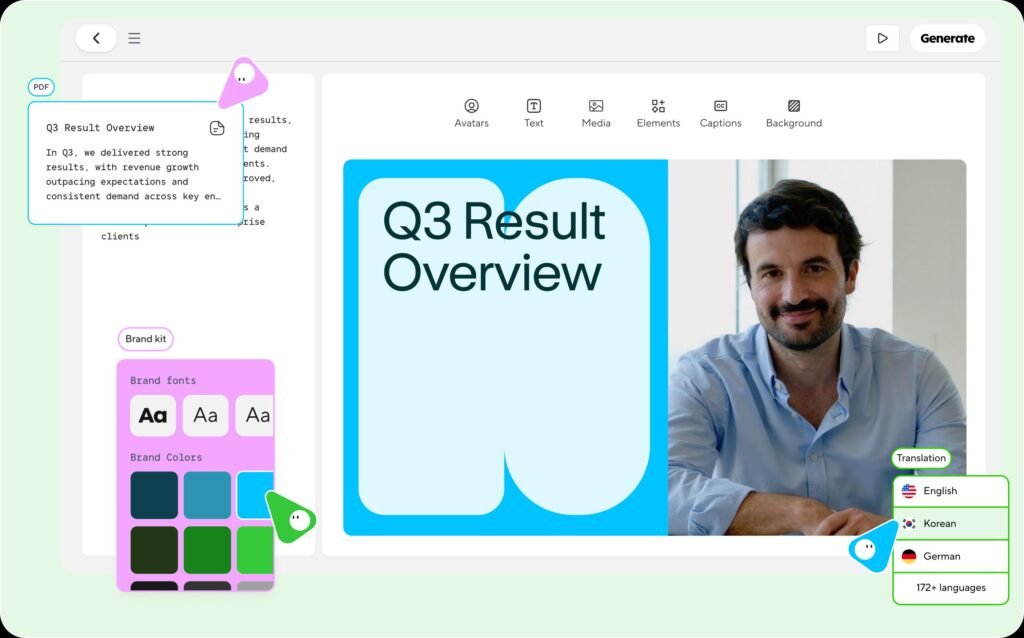
HeyGen’s AI Studio: a script editor on the left drives the avatar’s delivery on the right. Source: HeyGen.
User Experience
Interface: the browser-based editor is consistently described as approachable, writing a script functions like writing a document, with tone, pacing, and gestures responding directly to what is typed.
Learning curve: low for a first basic avatar video, higher for getting the most out of Voice Director, Voice Mirroring, and Gesture Control, and higher still for understanding exactly how the credit system spends against a specific plan.
Platforms: fully browser-based, with a documented API for teams wanting to build HeyGen into an existing product rather than using the web app directly.
The most common complaint pattern across independent reviews is not about video quality, it is about the credit system: users report that adding seats to the Business plan raises the monthly bill without expanding the shared credit pool, and that premium Avatar IV/V output consumes credits fast enough that the advertised plan minutes rarely match real production output.
AI Performance
Avatar realism: HeyGen holds G2’s #1 ranking for most realistic avatars, with an avatar-quality score of 9.2 out of 10, the category’s strongest reputation for output that reads as a real person rather than an obvious synthetic render.
Independent reviews: HeyGen sits at 4.8 out of 5 on G2 across more than 1,000 reviews and 4.7 out of 5 on Capterra across 313 verified reviews. The G2 Summer 2026 Reports gave HeyGen 281 badges and 23 number-one rankings, including for AI avatars, video translation, ease of use, and enterprise scalability.
The Trustpilot gap: despite the strong G2 and Capterra numbers, HeyGen sits at only 2.4 out of 5 on Trustpilot. Independent analysis attributes this gap largely to pricing and billing complaints rather than dissatisfaction with the actual video output, a meaningfully different pattern than the support-quality divides seen in some other AI tools.
Real Business Use Cases
Real estate: HeyGen launched a dedicated Real Estate product in 2026 for agents making listing walkthroughs and market-update videos without hiring a videographer for every property.
Course creators and training: Coursera’s CTO has described HeyGen as a critical part of their infrastructure, with customer-reported results including a 40 percent increase in video watch time and a 25 percent boost in course completion rates on content produced with it.
Localization: Trivago used HeyGen to localize TV ads across 30 markets, cutting post-production time roughly in half and saving 3 to 4 months per campaign, a concrete example of the translation feature at real commercial scale.
Sales and outreach: personalized video messages at scale are a documented use case, letting a small sales team send video outreach that would be impossible to record individually for every prospect.
Pricing Analysis
Confirm current numbers at heygen.com/pricing before purchasing; HeyGen has adjusted its credit rates more than once in 2026. Avatar III studio video runs about 3 credits per minute; Avatar IV and V studio video run in the range of 20 to 30 credits per minute depending on when you check, since the standard rate changed mid-year. That means Creator’s 600 credits cover roughly 20 to 30 minutes of premium Avatar IV/V video a month, not the unlimited video count the plan name implies.
| Plan | Price | Notes |
|---|---|---|
| Free | $0 | 3 videos/mo, 1 minute max, 720p, watermark, limited Avatar IV trial |
| Creator | $29/mo, $24/mo annual | 600 credits/mo, unlimited video count, up to 30 min/render, 1080p, no watermark |
| Pro | From $49/mo | 1,000 credits/mo, scales to higher credit tiers for heavier production needs |
| Business | $149/mo + $20/seat/mo | 1,500 credits, 4K export, custom avatars, shared workspace, SSO |
| Enterprise | Custom | SAML/SSO, SCIM provisioning, multi-workspace control, dedicated success manager |
API pricing runs separately from web plans: Avatar III at 1080p costs roughly $1.00 per minute, and Avatar V runs about $0.05 per second, or $3.00 per minute. One Reddit user running a production API pipeline reported a real-world cost of about $330 a month for their workload, a useful sanity check against the advertised entry price. Adding seats to a Business plan raises the bill without expanding the shared credit pool, a scaling trap worth budgeting around for a growing team.
Pros and Cons
Pros
- Rated the most realistic AI avatars on G2, with a 9.2/10 avatar-quality score, a genuinely strong reputation, not just marketing language
- The script-driven AI Studio editor is consistently described as approachable for non-technical users
- Video Translation into 175-plus languages with lip-sync is a real, well-documented feature backed by concrete customer results (Trivago’s 30-market localization)
- Mandatory on-camera identity verification for custom avatars, plus ML and human moderation, addresses the deepfake trust problem directly rather than leaving it unaddressed
- Company has grown to $200M ARR while remaining cash-flow break-even, a genuinely disciplined business, not one burning investor cash to subsidize pricing
- HeyGen has explicitly said its core customers are small business owners and solo professionals, not just enterprise logos
Cons
- Trustpilot rating of 2.4/5 sits far below G2’s 4.8/5, with the gap attributed mainly to pricing and billing complaints
- The credit system means a plan’s advertised price does not reflect real usable output; premium Avatar IV/V video consumes credits 6 to 10 times faster than standard Avatar III
- Adding seats to the Business plan increases the bill without increasing the shared credit pool, a real scaling trap for growing teams
- Credit rates have changed more than once in 2026, making long-term cost planning harder than a flat per-seat price would be
- API costs can scale well beyond the web plan price at production volume, one documented real-world example ran roughly $330/month
Comparisons
HeyGen vs. Synthesia
| HeyGen | Synthesia | |
|---|---|---|
| Starting price | $29/mo (Creator) | From $18/mo (Starter, reported) |
| Pricing model | Credit-based, varies by feature and avatar tier | Per-video-minute cap, generally more predictable |
| Standout strength | #1 rated avatar realism on G2 | Longer track record in corporate training and e-learning specifically |
| Best for | Marketing, sales outreach, and social content needing the most realistic avatar | Corporate training and compliance video at enterprise scale |
Bottom line: HeyGen’s edge is avatar realism and a broader creative toolset (Video Agent, Seedance 2.0 integration); Synthesia’s edge is a more predictable per-minute pricing model and a longer history in corporate e-learning specifically. Test both on the free tier against your actual script before committing to an annual plan.
HeyGen vs. Runway and Pika
Runway and Pika, both reviewed separately on this site, are built for generative, cinematic video rather than a consistent talking presenter. HeyGen occupies a different niche entirely: it is the tool for a recurring, identity-consistent avatar delivering a script, not for generating novel scenes or effects from a prompt.
Security and Privacy
AI avatar video has an obvious trust problem, and HeyGen addresses it directly rather than leaving it implicit: every custom avatar requires on-camera identity verification from the person depicted, with no verification meaning no avatar, and removal requests are honored. Generated content is scanned by ML systems the moment it is created, with trained human reviewers handling edge cases, and the company’s moderation policy explicitly bars violent content, political campaigning, and any content harming minors.
On the compliance side, HeyGen holds SOC 2 Type II certification and states compliance with GDPR, CCPA, the EU AI Act, and the Data Privacy Framework, backed by annual penetration testing and continuous vulnerability management. For a small business creating avatar video of real people, whether founders, employees, or hired talent, the identity-verification requirement is a genuine safeguard worth knowing about, not just a compliance checkbox.
Customer Support
Documentation: a help center, a community forum with how-to guides, a Discord server, and regular community meetups held in cities worldwide.
Independent reputation: the same pattern seen elsewhere in this category shows up here too, 4.8/5 on G2 and 4.7/5 on Capterra, against 2.4/5 on Trustpilot. The difference in this case is more specific than a general support divide: independent analysis attributes the Trustpilot gap mainly to pricing structure and billing complaints rather than dissatisfaction with support responsiveness or video quality itself.
To manage the risk: read the credit-cost table for your specific avatar tier before committing to a plan, and track your actual credit consumption in the first billing cycle before deciding whether to add seats or upgrade tiers.
Common Mistakes
- Reading “unlimited videos” on the Creator plan as unlimited premium output, the credit pool still caps how many minutes of Avatar IV/V video you can actually produce each month.
- Adding Business plan seats to scale a team without checking that the shared credit pool does not grow along with the seat count.
- Building a production pipeline on the API without separately budgeting for API costs, which run on a different rate than the web plan.
- Skipping the identity verification step for a custom avatar of an employee or spokesperson, which is required and non-negotiable, not optional.
- Committing to an annual plan before testing whether your specific script and avatar choice produce output you are happy with on the free tier first.
Expert Tips
- Draft and time your script with the cheaper Avatar III before rendering the final version in Avatar IV or V, reserving premium credits for the version viewers actually see.
- Track your real credit consumption for one full billing cycle before deciding whether Creator, Pro, or Business actually fits your production volume.
- If translation is a core need, test the lip-sync quality on your specific target languages before committing, since quality can vary by language pair.
- For a growing team, model the real cost of additional Business seats against the shared credit pool before assuming more seats means more usable output.
- If building on the API, request a small trial credit purchase first to measure real per-minute cost against your specific avatar and resolution choices.
Frequently Asked Questions
Is HeyGen good for small businesses?
Yes. HeyGen has said its core, lifeblood customers are small business owners, real estate agents, personal trainers, and course instructors, not just its enterprise logos. The Creator plan at $29/mo is built for exactly that scale.
How much does HeyGen cost?
Free for 3 short videos a month, Creator at $29/mo, Pro from $49/mo, and Business at $149/mo plus $20 per seat. All paid plans run on a credit system, so the real cost depends on which avatar tier you use. Confirm current pricing at heygen.com/pricing.
Is HeyGen worth the credit system’s complexity?
For businesses that need premium Avatar IV/V quality, the credit model reflects a real cost difference in generation. It is worth budgeting a full billing cycle to understand your actual usage before choosing a plan.
Is HeyGen reliable?
Avatar quality and platform reliability draw strong reviews (4.8/5 on G2, 4.7/5 on Capterra), but Trustpilot sits at only 2.4/5, driven mainly by pricing and billing complaints rather than output quality.
Does HeyGen verify identity for avatars?
Yes. Every custom avatar requires on-camera identity verification from the person depicted, and removal requests are always honored, a direct response to deepfake concerns around avatar video technology.
Is HeyGen better than Synthesia?
Neither is categorically better. HeyGen leads on avatar realism and creative tools; Synthesia offers more predictable per-minute pricing and a longer track record in corporate training specifically. Test both against your actual script before committing.
Final Verdict
HeyGen earns its reputation as the category leader in avatar realism, and it backs that reputation with real numbers: a #1 G2 ranking for realistic avatars, a 9.2/10 avatar-quality score, and a company that has grown to $200 million in annual revenue while staying cash-flow break-even, a genuinely disciplined business rather than one subsidizing growth with investor cash. The trust and safety approach, mandatory identity verification and active moderation, is also a real, substantive answer to the deepfake concerns that hang over this entire product category.
The honest complication is the credit system. A $29 Creator plan sounds simple until you learn that premium avatar video draws down credits 6 to 10 times faster than standard output, that adding team seats does not add to the shared credit pool, and that Trustpilot’s 2.4/5 rating is driven largely by exactly this kind of billing confusion. None of that erases the avatar quality; it does mean the real monthly cost of using HeyGen well takes more homework than the plan price suggests.
Who should buy it: small businesses, agencies, real estate professionals, and course creators who need a steady stream of professional, identity-consistent avatar video and are willing to track credit usage carefully.
Who should look elsewhere first: teams that want fully predictable per-minute pricing without a credit system to learn, or anyone whose primary need is generative, cinematic video rather than a consistent talking presenter.
Sources and References
HeyGen, official homepage and pricing, heygen.com
HeyGen: HeyGen doubles to $200M ARR in eight months, official company blog, June 25, 2026
Forbes-sourced reporting via Upstarts Media: HeyGen’s $200M ARR without the burn
G2 and Capterra: HeyGen review aggregation and Summer 2026 Grid Report
Trustpilot: HeyGen customer reviews
eesel AI, Arcade, Creatify, checkthat.ai: HeyGen pricing and credit-rate analysis, 2026
Bloomberg: HeyGen Series A funding coverage
Exploring the rest of our AI video and image coverage? See our Runway Review and Pika Review for generative video, or our Midjourney Review for AI image generation.