This Runway AI review looks at the platform that shows up when a brand wants a clip that looks directed, not just generated. The honest question for a small business is not whether Runway can produce a great-looking shot, it clearly can, it is whether the credit system and the company’s own support record make it a good deal for a team without a Hollywood budget.
The best output quality in AI video and the easiest tool to overspend on are, more often than not, the same product.
On this page
Runway’s official Gen-4.5 launch announcement. Source: Runway.
Executive Summary
Runway (legally Runway AI, Inc.) was founded in 2018 by Cristóbal Valenzuela, Anastasis Germanidis, and Alejandro Matamala-Ortiz, three NYU Tisch graduates, and is headquartered in New York City. It started as machine-learning tooling built for creators, contributed to the original Stable Diffusion research, and then built its reputation on the Gen series of video models. Runway’s technology was used in the Oscar-winning film “Everything Everywhere All At Once,” and the company has since signed production deals with Lionsgate and AMC Networks.
By February 2026, Runway had raised more than $855 million total, including a $315 million Series E at a $5.3 billion valuation led by General Atlantic with participation from Nvidia, Fidelity, Adobe, and AMD. The company reported roughly $300 million in annualized revenue by late 2025, and its founders said Runway added $40 million in new ARR in the second quarter of 2026 alone. Some of that fresh capital is now funding a pivot toward “world models”, AI systems trained to simulate physical environments rather than just generate clips, with the first release, GWM-1, shipping in March 2026 for use in robotics, drug discovery, and climate modeling.
None of that changes what a small business actually buys, though: access to Runway’s video and image generation suite. That means Gen-4.5 (the current flagship model, released December 2025), Gen-4, Gen-4 Turbo, the Aleph video-editing model, the Act-Two character-performance tool, and, as of July 2026, a marketplace of third-party models including Google’s Veo 3.1, Kuaishou’s Kling 3.0, ByteDance’s Seedance 2.0, and Black Forest Labs’ FLUX, all drawing from one shared credit pool.
Who this Runway AI review is for: marketing teams, agencies, and content creators trying to decide whether Runway’s professional-grade toolset is worth its credit-based pricing and known customer-support friction, next to cheaper, narrower competitors like Kling and Pika.
Quick Verdict
| Category | Rating / Notes |
|---|---|
| Overall Rating | 7.5 / 10 |
| Ease of Use | 6 / 10, powerful tools like Aleph and Act-Two carry a real learning curve |
| Features | 9 / 10, Gen-4.5, Aleph, Act-Two, plus a growing third-party model marketplace |
| AI Capabilities | 9 / 10, benchmark-topping character and physics consistency |
| Customer Support | 3.5 / 10, widespread complaints about refunds and unresponsive support |
| Integrations | 6.5 / 10, strong API and Runway Dev platform, fewer native no-code business integrations |
| Automation | 6 / 10, Workflows and Recipes cover common production tasks, not a full marketing-automation suite |
| Value for Money | 5.5 / 10, credit burn accelerates fast at higher-quality settings |
| Scalability | 7 / 10, Enterprise tier adds SOC 2, IP indemnification, and a 99.9% uptime SLA |
| Best For | Agencies and marketing teams making brand-consistent video who can budget for credit costs |
What Is Runway?
Runway launched in 2018 as a set of machine-learning tools built for creators rather than researchers, and its team contributed to the original Stable Diffusion research before diffusion-based image and video generation became mainstream. The company built its early reputation on the Gen series: Gen-1 and Gen-2 established the video-generation category, Gen-3 Alpha (mid-2024) meaningfully improved motion quality, and Gen-4 introduced stronger character and object consistency across shots. Gen-4.5, released in December 2025, is the current flagship and was reported to rank first on the Video Arena text-to-video leaderboard, a third-party evaluation platform, at launch.
Runway is based in New York City and had approximately 516 employees as of mid-2026. Cristobal Valenzuela and Anastasis Germanidis serve as co-CEOs. In July 2026 the company launched Runway Dev, described as “the AI media platform for developers: one API to integrate the best image, video, audio and real-time character models.” Runway Dev is built around four surfaces: Models (first-party Gen-4.5, Aleph, and Act-Two, plus third-party models like Seedance and ElevenLabs), Recipes (prebuilt endpoints such as Ad Localization, Product Ad, Product Swap, and Marketing Stock Image), Workflows (custom multi-model pipelines), and Characters (interactive avatars with voice and tool-calling). Named enterprise customers include Adobe, ElevenLabs, Shutterstock, Figma Weave, and Gamma.
Key Features
Gen-4.5 and Gen-4 (Text-to-Video and Image-to-Video)
Runway’s flagship models turn a text prompt or a still image into a video clip with strong character, object, and physics consistency across the shot, widely regarded as the most reliable in the category for repeated character appearances. Native output is 720p, with 4K available through separate upscaling credits, and frame rate is locked at 24 fps.
Gen-4 Turbo
A faster, lower-cost image-to-video model built for quick iteration rather than final-pass quality, useful for testing a concept before committing credits to a full Gen-4.5 render.
Aleph (Video-to-Video Editing)
Aleph edits existing footage rather than generating from scratch: new camera angles, scene extensions, lighting and atmosphere changes, object removal, and style transfer, all from a text prompt applied to a clip that already exists.
Act-Two (Character Performance)
Released July 22, 2025 as the successor to Act-One, Act-Two takes a driving performance video plus a character reference image and renders a synthesized performance where the character mimics the original actor’s expressions, head motion, and body language, without a motion-capture suit. A voice-control add-on released the following month accepts a separate audio file and syncs mouth shapes to it.
Third-Party Model Marketplace
A single Runway subscription now also grants access to Google’s Veo 3.1, Kuaishou’s Kling 2.1 and Kling 3.0, ByteDance’s Seedance 2.0 and Seedream, and Black Forest Labs’ FLUX image models, all billed from the same credit pool. Trade press has called this Runway’s “App Store moment”, positioning the company as a storefront layer rather than a single-model vendor.
Runway Video Editor
A browser-based timeline editor sits inside the app for trimming, color, and assembling a final cut, so generation and post-production do not require exporting to a separate tool.
User Experience
Dashboard: browser-based, centered on prompt entry, model selection, and a credit balance that updates in real time as you generate.
Learning curve: low for a first basic clip, considerably steeper for getting consistent, professional results out of Aleph and Act-Two, both of which reward users who already think in shots and camera language.
Mobile: an iOS app launched in February 2026 with Gen-4.5 access and a Chat Mode for conversational generation.
A recurring theme across independent reviews and Reddit’s r/runwayml: the interface itself is well-regarded, but users consistently report failed or low-quality generations still consuming credits, a pattern Runway’s own help documentation acknowledges as a “recognized, recurring” issue.
AI Performance
Output quality: Gen-4.5 is widely cited as one of the best consumer-accessible video models for character and physics consistency, though one head-to-head benchmark found Gen-4 running roughly 4.4 times slower than Kling to generate a comparable clip.
Clip length: Runway’s generations are capped around 10 seconds per pass, well short of Kling’s single-pass clips of up to two to three minutes, which pushes longer-form Runway projects toward a stitch-multiple-clips workflow.
Audio: Google’s Veo 3 remains the category benchmark for native audio generated alongside video in a single pass. Runway’s audio tools (Generative Audio, Lip Sync Video) are strong but generally applied as a separate step rather than generated natively with the clip.
Where Runway wins outright: independent testers consistently point to Act-Two’s performance capture and Aleph’s post-generation editing as tools without a direct equivalent at Kling or Veo, which matters most for narrative and brand-consistent work rather than raw one-shot generation quality.
Real Business Use Cases
Marketing and ad agencies: Runway Dev’s prebuilt Recipes (Ad Localization, Product Ad, Product Swap, Multi-Shot Video, Marketing Stock Image) are built specifically for the kind of repeatable, templated video work agencies bill for.
Ecommerce brands: Product Swap and Product Ad recipes can generate multiple styled variations of the same product shot without a new photo shoot for every variant.
Filmmakers and previsualization: Act-Two paired with Gen-4 environment plates and an Aleph cleanup pass is a documented pipeline among independent filmmakers for turning a rough performance into a polished shot before committing to full production.
Social and content teams: workable for short promotional clips, but the 10-second generation ceiling and credit cost mean this is not the cheapest option for high-volume daily social content, where Kling or Pika’s lower per-clip cost is usually the better fit.
Pricing Analysis
Confirm current numbers at runwayml.com/pricing before purchasing. Runway has changed its plan structure more than once in the past year, and credit rates vary by model.
| Plan | Monthly Price | Annual Price | Credits / mo | Notes |
|---|---|---|---|---|
| Free | $0 | $0 | 125 (one-time) | Not a recurring free tier, a one-time trial allowance, does not renew monthly |
| Standard | $15/mo | $12/mo | 625/mo | Roughly 25 seconds of Gen-4.5, or up to about 125 seconds on Gen-4 Turbo |
| Pro | $35/mo | $28/mo | 2,250/mo | Roughly 90 seconds of Gen-4.5; API access included |
| Max | $95/mo | $76/mo | 9,500/mo | Roughly 380 seconds of Gen-4.5; replaced the old “Unlimited” plan |
| Enterprise | Custom | Custom | Custom | SOC 2 Type II, IP indemnification, SSO, 99.9% uptime SLA |
Runway retired its old “Unlimited” plan in 2026 after users publicly noted it charged nearly three times the Pro price for the identical 2,250-credit allowance. Existing Unlimited subscribers were scheduled to migrate to the new Max plan by September 1, 2026. Paid editors share one credit pool rather than each getting their own allotment, so a small team should budget seats and generation credits separately. Credit costs also vary sharply by model and output: Aleph editing runs about 15 credits per second, Gen-4.5 video runs roughly 25 credits per second, and Gen-4 Turbo image-to-video is considerably cheaper per second, so switching models for a look can more than triple the cost of the same shot.
Pros and Cons
Pros
- Best-in-class character, object, and physics consistency for professional and narrative work (Gen-4, Gen-4.5)
- Aleph unlocks edit-on-existing-footage workflows with no close equivalent elsewhere
- Act-Two delivers credible performance capture without a motion-capture suit
- A real browser-based video editor lives inside the app, not just a generator
- A single subscription now also grants access to Veo 3.1, Kling 3.0, and other third-party models
- Royalty-free, commercial-use generations with copyright ownership per Runway’s terms
- Used in award-winning film production and holds enterprise deals with Lionsgate and AMC Networks
Cons
- Customer support draws consistently harsh reviews; Trustpilot shows most of 155-plus reviews rating the service poorly, with recurring refund-runaround complaints
- Credit burn accelerates sharply at higher-quality settings, and failed generations have repeatedly been reported as still consuming credits
- No permanent free plan, the free tier is a one-time, non-renewing trial allowance
- 10-second generation ceiling per clip, versus 2-3 minute single-pass generations from Kling
- Native output caps at 720p, 4K requires separate upscaling credits, and frame rate is locked at 24 fps
- The company is a defendant in an active, unresolved copyright lawsuit from visual artists over AI training data
Comparisons
Runway vs. Kling AI
| Runway | Kling AI | |
|---|---|---|
| Starting price | $12/mo (Standard, annual) | From $6.99/mo (reported) |
| Max single-pass clip length | ~10 seconds | Up to 2-3 minutes |
| Best for | Character-consistent narrative shots, in-video editing (Aleph) | Fast iteration, longer single-pass clips, lower cost per generation |
| Editing toolchain | Full video editor, Aleph, Act-Two | Less mature post-production integration |
Bottom line: choose Kling to iterate on motion and concept cheaply and quickly; choose Runway when a shot needs character consistency or post-generation editing that Kling’s toolchain does not yet match. As of February 2026, Kling 3.0 is also available inside Runway’s own platform, an acknowledgment of the competition.
Runway vs. Google Veo 3
Veo 3 is widely described as the current quality benchmark for camera physics and native audio generated in the same pass as the video. Runway’s defensible ground against Veo is toolchain depth, Act-Two performance capture, Aleph editing, and Multi-Motion Brush have no direct equivalent in Veo. For production work where those specific tools matter, Runway is hard to replace; for raw generation quality per dollar, Veo is a genuine challenge. Veo 3.1 is also available inside Runway as a third-party model.
Runway vs. Pika
Pika, reviewed separately on this site, leans into stylized, novelty-driven effects at a lower price point and is a better fit for high-volume, lower-stakes social content. Runway’s strength is the opposite end of the spectrum: brand-consistent, editable, professional-grade output for teams that can budget for it.
Performance Testing
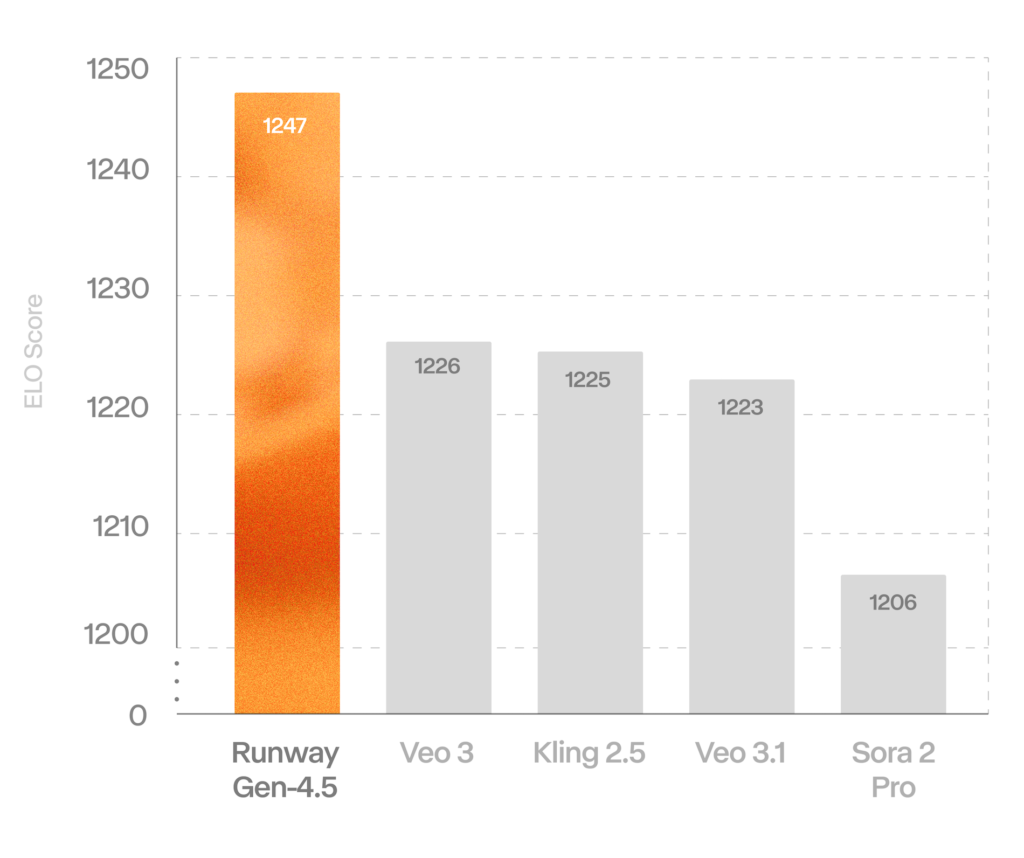
Artificial Analysis Text-to-Video benchmark at Gen-4.5’s December 2025 launch. Source: Runway.
Independent evidence, not invented for this review, reports the following:
- Gen-4.5 was reported to rank first on the Video Arena text-to-video leaderboard, a third-party evaluation platform, at its December 2025 launch.
- One published benchmark measured Gen-4 as roughly 4.4 times slower than Kling to generate a comparable clip.
- Community and independent-reviewer consensus (Reddit’s r/runwayml, multiple published reviews) consistently flags credit consumption on failed or unusable generations as the most common practical complaint, alongside praise for output quality and rapid feature releases.
- Runway’s own help documentation confirms that credits are automatically refunded when a generation ends in a genuine system error, typically within a few minutes, though user reports on Trustpilot and in Runway’s community forum describe cases where that refund did not occur as described.
Security and Privacy
Per Runway’s stated enterprise terms: SOC 2 Type II compliance, IP indemnification for generated content, and a 99.9% uptime service-level agreement are available on the Enterprise tier, along with single sign-on and per-model cost visibility for teams managing usage across a marketplace of models.
Runway states that paid-tier generations are commercial-use and royalty-free, with the user retaining ownership of output. That said, Runway is currently a defendant in a lawsuit brought by visual artists alleging its models were trained on copyrighted artwork without permission or compensation; Runway has argued the fair-use doctrine shields it from liability, and the outcome remains unresolved as of this review. Businesses in visually sensitive industries, or those requiring contractual IP indemnification for AI-generated assets, should treat the Enterprise tier’s indemnification terms, and the pending litigation, as a genuine part of the purchase decision rather than fine print.
Customer Support
Documentation: a help center and community forum exist, along with in-app support and a stated 48-hour response time for VIP-tier members.
Independent reputation: this is Runway’s weakest category by a wide margin. Trustpilot lists 155-plus reviews for the main runwayml.com domain, with most reviewers describing a negative overall experience; a separate runway.ai listing shows a similar pattern. Recurring specific complaints include chatbot-only support loops that fail to resolve billing disputes, refund requests redirected repeatedly to app-store channels, and credits deducted for generations that failed to complete.
To manage the risk: keep a written record of any failed generation (screenshot plus timestamp) before contacting support, and budget for the practical reality that a support ticket may take considerably longer to resolve than Runway’s stated response times suggest.
Common Mistakes
- Assuming the advertised credit-per-second rate is the real cost of a finished clip; failed and discarded attempts spend the same credits as a keeper, so realistic budgeting needs a retry multiplier, not the sticker rate.
- Choosing a higher tier for “more credits” without checking whether Gen-4.5’s higher per-second cost, not the plan itself, is what is actually draining the balance.
- Committing to annual billing before testing the specific model and workflow, Aleph, Act-Two, or straight Gen-4.5 generation, your business actually needs.
- Publishing a first-pass generation without a locked seed, then being unable to reproduce a client-approved look on a later shot.
- Treating the free trial’s one-time credits as an ongoing free tier, then being surprised when generation stops mid-project.
Expert Tips
- Test your specific use case, Aleph editing, Act-Two performance, or straight generation, on the lowest paid tier before committing to Pro or Max.
- Lock your generation seed once you find a look you like, then use Aleph for small follow-up edits instead of regenerating the whole clip from scratch.
- Use Gen-4 Turbo for cheap early iteration, and reserve Gen-4.5 credits for the final, client-facing pass.
- Document every failed generation immediately; Runway’s official policy is to auto-refund credits for genuine system errors, but community reports suggest this does not always happen automatically.
- If your monthly need is a small number of longer, single-pass clips rather than many short ones, price out Kling AI alongside Runway before committing to a plan.
Frequently Asked Questions
What is Runway used for?
An AI platform for generating, editing, and assembling video and image content, used by marketers, agencies, and filmmakers for everything from social clips to professional pre-production.
Is Runway good for small businesses?
It depends on the use case: strong for brand-consistent, editable video work; less cost-efficient for high-volume, low-stakes daily social content, where cheaper tools cover that need.
How much does Runway cost?
Standard $12/mo, Pro $28/mo, and Max $76/mo, all billed annually (higher if billed monthly), plus a one-time 125-credit free trial. Confirm current pricing at runwayml.com/pricing.
Does Runway have a free plan?
Not an ongoing one. The free tier is a one-time trial allowance, not a renewing monthly plan.
Is Runway reliable?
Output quality is well regarded, but customer support and billing-dispute resolution are consistently the most criticized part of the experience across independent review sites.
Is Runway still worth it in 2026?
Yes, for businesses that need Gen-4.5-level video quality, Aleph editing, or Act-Two performance capture and can budget for the credit system; less so for businesses that only need cheap, high-volume short clips.
Final Verdict
The short version of this Runway AI review: Runway earns its reputation as one of the most capable AI video platforms available in 2026: Gen-4.5’s character and physics consistency, Aleph’s edit-on-existing-footage workflow, and Act-Two’s performance capture together form a toolset without a direct equivalent at any single competitor. That is a genuine, well-documented strength, not marketing language.
The honest complication is everything around that toolset: a credit system that burns fast at higher-quality settings, a documented pattern of credits being consumed by failed generations, and a customer-support reputation that ranks among the worst in the category on independent review sites. None of that erases the product’s quality; it does mean the real cost of using Runway well is higher, in both money and patience, than the plan price suggests.
Who should buy it: agencies, marketing teams, and filmmakers who need professional-grade, brand-consistent video and are prepared to budget credits carefully and document any billing dispute in writing.
Who should look elsewhere first: businesses needing only occasional, low-stakes social clips (Kling or Pika will be cheaper), and any business for whom a smooth, responsive support experience is a hard requirement.
Sources and References
Runway official pricing, runwayml.com/pricing
Runway official news, runwayml.com/news
Trustpilot, Runway customer reviews, runwayml.com and runway.ai listings
TechCrunch, Runway funding and company reporting, 2026
Tracxn, Runway company profile and funding data
AI Wiki, Runway Gen-4 and Act-Two documentation
Independent testing and review sources cross-referenced for pricing, credit rates, and benchmark claims
Comparing AI video tools for your business? Read our Pika Review or Midjourney Review, or see our Small Business Marketing Growth playbook. Or see how we help small businesses implement these tools.
Need an AI talking-head presenter rather than generative video? See our full HeyGen Review for avatar quality, pricing traps, and how it compares to Synthesia.