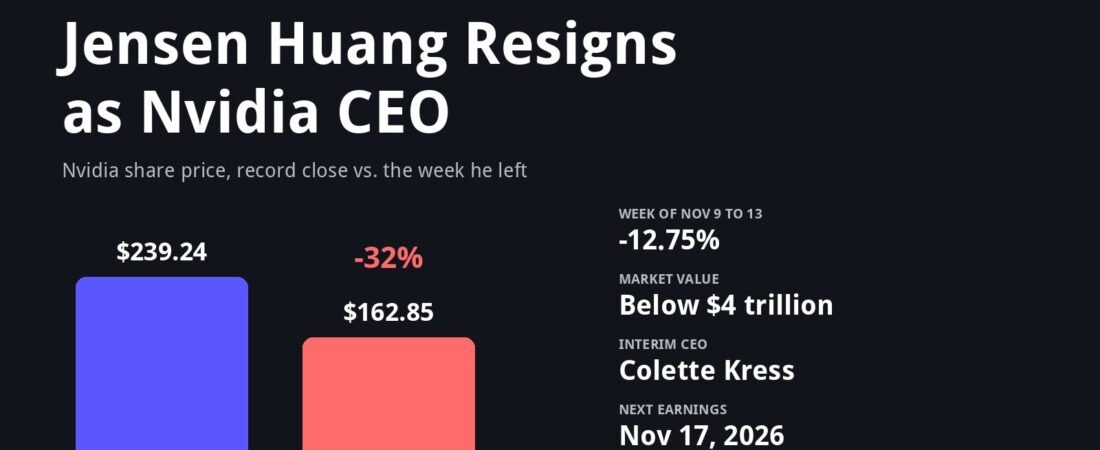
Jensen Huang, the man who built Nvidia into the engine of the AI boom, resigned as CEO on November 12, 2026, after a week of reports about extramarital relationships, an alleged Chinese intelligence asset and a board ready to remove him. Here is why Jensen Huang resigned, what is confirmed and what is not, who runs Nvidia now, and what it means for the AI tools your business depends on.
Resigned
Nov 12, 2026
Interim CEO
Colette Kress
Stock this week
-12.75%
Earnings
Nov 17
In this article
- The Short Answer: Why Did Jensen Huang Resign?
- What Happened: The Full Timeline
- Why Did Jensen Huang Really Resign?
- Who Is Alice Huang, and What Is Megaspeed?
- Who Is Running Nvidia Now?
- How Did Nvidia Stock React?
- What Happens Next?
- Why This Matters for the Whole AI Industry
- What It Means for Small Businesses Using AI Tools
- FAQ
- Sources
The Short Answer: Why Did Jensen Huang Resign?
Jensen Huang resigned as Nvidia’s president, CEO and board member on November 12, 2026, effective immediately. Nvidia’s official filing gives no reason. The resignation came four days after Huang admitted to employees that he had been unfaithful to his wife, and one day after The Wall Street Journal reported that Nvidia’s board was preparing to remove him.
The scandal began with an October 29 New York Times report that U.S. officials believed Alice Huang, a former executive at Nvidia customer Megaspeed, was a Chinese intelligence asset. It escalated when the Times reported a second relationship, with an Nvidia vice president who reported to him. Chief Financial Officer Colette Kress is now interim CEO.
Key facts at a glance
- Who: Jensen Huang, who co-founded Nvidia in 1993 and led it for 33 years.
- When: The board accepted his resignation on November 11, 2026. Nvidia announced it on November 12.
- Official reason: None given in Nvidia’s SEC filing or press release.
- Interim CEO: Colette Kress, Nvidia’s CFO since 2013, who keeps the CFO job too.
- New board chair: Harvey C. Jones, former CEO of Synopsys and a director since 1993. He is Nvidia’s first-ever board chair.
- Stock impact: Down 12.75% for the week, closing at $162.85 on November 13 and below a $4 trillion market value for the first time since July 2025.
- What’s next: Earnings on November 17 and a congressional briefing request for November 18.
What Happened: The Full Timeline
The story moved fast. Here is what happened, in order, with the source for each step.
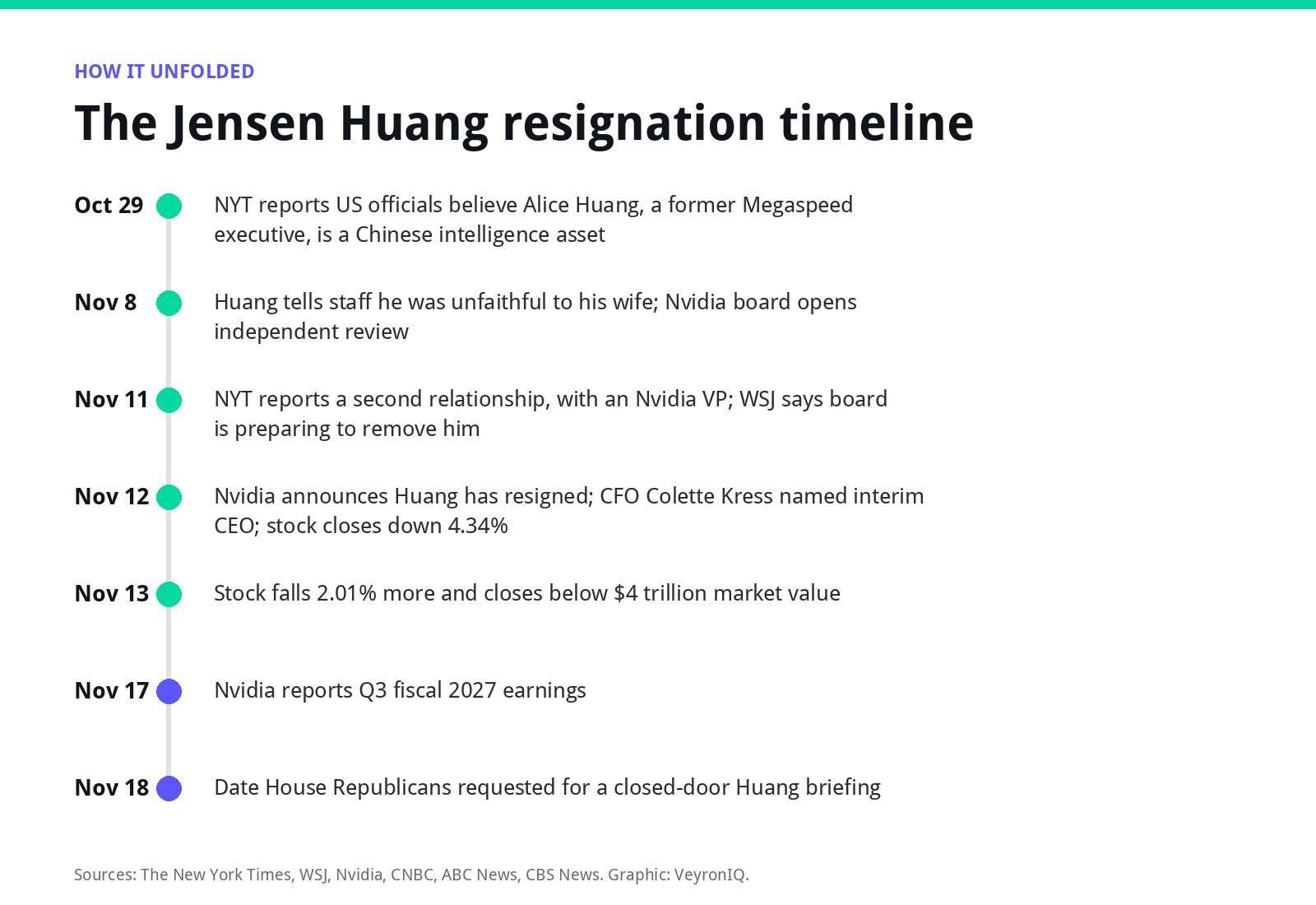
The Jensen Huang resignation timeline, from the first report on October 29 to the congressional briefing requested for November 18. Graphic: VeyronIQ.
| Date (2026) | What happened | Source |
|---|---|---|
| Oct 6 | Nvidia stock hits a record close of $239.24 | Tech Times |
| Oct 29 | The New York Times reports U.S. officials concluded that Alice Huang, a former Megaspeed executive (no relation to Jensen Huang), was a Chinese intelligence asset | NYT, via ABC News and Tech Times |
| Nov 8 (Sun) | Huang tells staff in a letter that he was “unfaithful” to his wife and apologizes. Nvidia’s board opens an independent investigation into reports that he was “the target of a foreign intelligence effort” | Nvidia board statement; ABC News |
| Nov 9 (Mon) | President Trump says Huang told him he “had no idea that she was a spy” and that he believes him | ABC News; CBS News |
| Nov 11 (Wed) | The Times reports a second relationship, with an Nvidia vice president who reported to Huang. The Wall Street Journal reports the board is preparing to remove him. The board meets that night | NYT; WSJ; Yahoo Finance |
| Nov 11 | The board accepts Huang’s resignation, effective immediately | Nvidia Form 8-K |
| Nov 12 (Thu) | Nvidia announces the resignation and names Colette Kress interim CEO. Reuters reports a third relationship, with a second unnamed employee. The stock falls as much as 14% before closing down 4.34% | Nvidia; Reuters, via CNBC |
| Nov 13 (Fri) | The stock falls another 2.01% to $162.85 and closes below $4 trillion in market value. HSBC downgrades Nvidia to Hold | CNBC; Yahoo Finance |
| Nov 17 | Nvidia reports third-quarter fiscal 2027 earnings | Nvidia |
| Nov 18 | Date House Republicans requested for a closed-door briefing with Huang | ABC News |
Why Did Jensen Huang Really Resign?
Officially, nobody has said. Nvidia’s Form 8-K filing and press release announce the resignation without giving a reason, and they do not mention whether the board’s independent investigation has finished.
What we do know comes from news reports and from Huang himself:
- The foreign intelligence question. Nvidia’s board opened its investigation on November 8 “in light of recent reporting” that Huang had been the target of a foreign intelligence effort. The board said at the time that it had “no reason to believe that either national security or NVIDIA secrets were compromised.”
- Huang’s admission. In his November 8 letter to employees, Huang wrote that he had been unfaithful to his wife and that “there is no excuse for what I did,” according to ABC News. The letter did not name anyone.
- A relationship with a direct report. The Times’ November 11 report of a relationship with a vice president who reported to Huang appears to have been the turning point. Bernstein analyst Stacy Rasgon told CNBC that an alleged affair with a direct report made it “much tougher for the board to leave him in position.” Huang, the executive and Nvidia did not comment on that report, according to CBS News.
Most large companies have policies about romantic relationships between executives and the people who report to them, because they create conflicts of interest. Within hours of the Journal reporting that the board was preparing to act, Huang was gone.
What has not been proven
No court or government agency has publicly found that Jensen Huang shared Nvidia secrets or broke any law. China’s Foreign Ministry called the spy reports “baseless” and “slander.” Nvidia’s board investigation, a Justice Department inquiry into Megaspeed and a securities lawsuit are all still open. Treat anything beyond the facts in this article as unconfirmed.
Who Is Alice Huang, and What Is Megaspeed?
Alice Huang is a former top executive at Megaspeed International, a Singapore-based data and cloud company that bought billions of dollars of Nvidia chips and hardware, according to CBS News. She is not related to Jensen Huang.
Here is what has been reported about her and the company, and by whom:
- The intelligence claim. The New York Times reported that U.S. intelligence agencies have believed for months that she was recruited by China’s Ministry of State Security.
- Where she is now. Bloomberg reported that she has returned to China and lives in Beijing with the knowledge of Chinese security officials.
- Chip sales. The Information reported that she was involved in companies that facilitated about $7.5 billion in chip sales to China. Nvidia has not confirmed this.
- Huawei links. CNBC reported that she is tied to Huawei, Nvidia’s biggest competitor in China, and may have owned stakes in Chinese businesses that benefited Huawei while doing business with Nvidia.
- Justice Department. Two law enforcement sources told CBS News that the Justice Department is investigating Megaspeed for possible violations of U.S. export restrictions on advanced AI chips. Megaspeed said it welcomes government scrutiny.
Nvidia’s position. Before the resignation, an Nvidia spokesperson said Huang’s interactions with Alice Huang were part of his job and “not unusual or unexpected.” Nvidia has denied involvement in illegal chip transfers and said it hired a leading U.S. law firm to verify its export control compliance. Neither Alice Huang nor Megaspeed responded to ABC News’ requests for comment.
Who Is Running Nvidia Now?
Colette Kress, interim CEO. Kress, 59, has been Nvidia’s chief financial officer since September 2013 and will keep that role while serving as interim CEO. Before Nvidia, she spent nearly 25 years in finance roles at Cisco and Microsoft. “Our focus remains on serving our customers, partners, developers and shareholders,” she said in Nvidia’s announcement.
Harvey C. Jones, board chair. Jones, 73, has been an Nvidia director since 1993 and becomes the board’s first-ever chair. He led chip-design software maker Synopsys from 1987 to 1998, first as CEO and then as executive chairman. He said the board has “full confidence in Colette and the leadership team.”
The search for a permanent CEO. Nvidia says it will consider internal and external candidates and has not given a timeline. Yahoo Finance reported that the names being discussed include Ian Buck, Nvidia’s head of hyperscale and high-performance computing, who created the CUDA software that turned Nvidia’s chips into general-purpose AI engines; Rene Haas, CEO of chip designer Arm; and Nvidia co-founder Chris Malachowsky. None of them has been confirmed as a candidate by Nvidia.
How Did Nvidia Stock React?
Nvidia shares have been falling since the first reports. The key numbers:
- November 12: shares fell as much as 14% after the announcement, then recovered to close down 4.34%, CNBC reported.
- November 13: shares fell another 2.01% to close at $162.85, below a $4 trillion market value for the first time since July 2025.
- The week: down 12.75%, Nvidia’s sixth straight weekly decline and its longest losing streak since 2012.
- From the peak: the November 13 close is about 32% below the October 6 record of $239.24.
Wall Street is split. At least ten analysts have downgraded Nvidia from Buy to Hold, according to Yahoo Finance:
| Analyst | What they said |
|---|---|
| Bernstein (Stacy Rasgon) | Cut its price target from $400 to $200. “Jensen is Nvidia,” he told CNBC, and it is unclear who could make the decisions for the next ten years |
| HSBC (Frank Lee) | Downgraded to Hold, cut its target from $365 to $170. Investor confidence is “shaken” because the succession plan is unclear, though fundamentals remain intact |
| Questar Capital (Richard Reyle) | Before the resignation, said losing Huang without a successor in place would make Nvidia “uninvestable,” though not the wider AI trade |
| Wedbush (Matthew Bryson) | “Nothing has changed.” Expects Nvidia to beat its forecast and guide higher next week |
What Happens Next?
Several dates and open questions will decide how this story ends:
- November 17: earnings. Nvidia reports third-quarter fiscal 2027 results at about 1:20 p.m. PT, with a call at 2 p.m. PT. Analysts expect earnings per share of $2.47 on revenue of $109.2 billion, according to Yahoo Finance. It will be Kress’s first earnings call as interim CEO.
- November 18: Congress. Republicans on the House Select Committee on China asked Huang to attend a closed-door briefing about his relationship with Alice Huang. House Foreign Affairs Chair Brian Mast said he was prepared to subpoena Huang if he did not respond. CNBC’s live coverage later reported that Huang agreed to testify.
- The board’s investigation. Nvidia has not said whether its independent review is finished or whether it will publish findings.
- The Justice Department. The inquiry into Megaspeed’s possible export violations is ongoing, according to CBS News.
- A securities lawsuit. Nvidia faces a lawsuit accusing it of failing to disclose information about Huang’s relationship with the alleged spy, CBS News reported.
- The CEO search. Whoever Nvidia picks will inherit the most important company in the AI hardware business.
Why This Matters for the Whole AI Industry
Nvidia is not just another tech company. Its chips train and run a large share of the world’s AI models, which is why CNBC has called it “the central bank of AI.” Stephane Houri of ODDO BHF told CNBC that the architecture of the AI industry “really depended on the vision” of Huang.
Three things are worth watching:
- Export rules. Late last year, the Trump administration allowed Nvidia to sell H200 chips to approved Chinese customers, with the federal government taking 25% of the sales. HSBC’s Frank Lee wrote that one possible outcome of the investigations “could be enhanced export restrictions,” which could hit Nvidia’s revenue.
- Pricing power. Lee also warned that a new CEO may struggle to keep “the same pricing power with customers and the same bargaining power with suppliers.” If Nvidia’s grip loosens, rivals like AMD and Broadcom, and in-house chips from big cloud companies, could gain ground.
- Demand is not the problem. Analysts including HSBC and Wedbush agree AI demand is still strong. HSBC noted that Nvidia has secured enough supply to deliver the 70% year-over-year revenue growth it outlined last quarter, and Yahoo Finance reported that sales are locked in well ahead, so this quarter and next should not be affected.
What It Means for Small Businesses Using AI Tools
If you run a small business, you probably don’t own Nvidia chips. But you almost certainly use AI tools that run on them. Here is our practical read.
In the short term, nothing changes for you. The AI tools you rely on, from chatbots to design and writing assistants, run in data centers full of chips (many of them Nvidia’s) that were bought and installed months ago. Nvidia’s sales are locked in well in advance, so a leadership change this week will not change your AI subscription price or slow your tools down.
In the medium term, watch AI prices. The cost of AI tools depends heavily on the cost of computing power. If Nvidia loses pricing power, AI tools could eventually get cheaper. If new export restrictions disrupt the chip market, prices could move the other way. Either way, it is a good reason to review your AI subscriptions every few months. Our AI Tools for Small Business Buyer’s Guide compares current prices.
The bigger lesson is about key-person risk. Analysts are not panicking about Nvidia’s chips. They are worried that one person was so central that nobody knows who comes next. “Jensen is Nvidia,” as Bernstein’s Rasgon put it. Many small businesses have the same problem on a smaller scale.
A 15-minute key-person checklist for your business
- ☐ Write down the three things only you know how to do, and who could step in for each.
- ☐ Store passwords, supplier contacts and client details where a trusted second person can reach them.
- ☐ Make sure your website, domain and email are not tied to one person’s personal account.
- ☐ Document your main processes. AI tools like Notion AI can turn rough notes into clear step-by-step guides.
- ☐ Put a simple policy in writing about conflicts of interest, including relationships at work, before you ever need it.
Jensen Huang Resignation FAQ
Nvidia has not given an official reason. Huang resigned on November 12, 2026, four days after admitting to employees that he had been unfaithful to his wife and one day after reports that the board was preparing to remove him. The New York Times had reported a relationship with Alice Huang, whom U.S. officials believe is a Chinese intelligence asset, and a second relationship with an Nvidia vice president who reported to him.
Officially, he resigned. Nvidia’s SEC filing says the board accepted his resignation on November 11, 2026, effective immediately. The Wall Street Journal had reported hours earlier that the board was preparing to oust him, and Yahoo Finance reported that the board met that night and decided to remove him.
Colette Kress, Nvidia’s chief financial officer since 2013, is interim CEO while she keeps the CFO role. The board is searching for a permanent CEO and will consider internal and external candidates. Harvey C. Jones became the board’s first-ever chair.
Alice Huang is a former top executive at Megaspeed International, a Singapore-based company that bought billions of dollars of Nvidia chips. The New York Times reported that U.S. intelligence agencies believe she was recruited by China’s Ministry of State Security. She is not related to Jensen Huang. China has called the spy reports baseless, and she did not respond to requests for comment.
There is no public evidence of that. Nvidia’s board said it had no reason to believe national security or Nvidia secrets were compromised, and Trump said Huang told him he had no idea the woman was a spy. Nvidia’s investigation and a Justice Department inquiry into Megaspeed are still ongoing.
Shares closed down 4.34% on November 12, 2026, after falling as much as 14% during the day, and fell another 2.01% on November 13 to $162.85. The stock lost 12.75% that week and closed below a $4 trillion market value for the first time since July 2025.
Nvidia reports third-quarter fiscal 2027 results on Tuesday, November 17, 2026, at about 1:20 p.m. PT, with an earnings call at 2 p.m. PT.
Not in the short term. AI services run on chips that were bought and installed months ago, and Nvidia’s sales are locked in well in advance. Longer term, changes to Nvidia’s pricing power or new export restrictions could affect what AI computing costs.
Nvidia’s filing does not describe any change to his shareholding or any severance terms. It only states that he resigned as president, CEO and director.
Sources and References
Corporate facts come from Nvidia’s SEC filing and board statement. Everything else is attributed to the news organization that reported it. Reports by The New York Times, The Wall Street Journal, Reuters, Bloomberg and The Information are cited as relayed by the outlets below. Last updated November 13, 2026.
- Nvidia: Form 8-K, CEO transition announcement (Nov 12, 2026)
- Nvidia: Statement from NVIDIA Board of Directors (Nov 8, 2026)
- CNBC: Nvidia stock closes down over 4% after CEO Jensen Huang announces resignation
- CNBC: Nvidia closes below $4T market cap for first time since July 2025 in Huang fallout
- CBS News: Nvidia board preparing to oust CEO Jensen Huang
- ABC News: Nvidia board reportedly preparing to oust CEO Jensen Huang
- Yahoo Finance: Nvidia live updates after Jensen Huang resigns
- Tech Times: Jensen Huang resigns, interim CEO Kress keeps CFO job before earnings
Free newsletter
Get new AI reviews in your inbox
One email when we publish a new honest review or practical guide. No spam, unsubscribe in one click.


Start the discussion