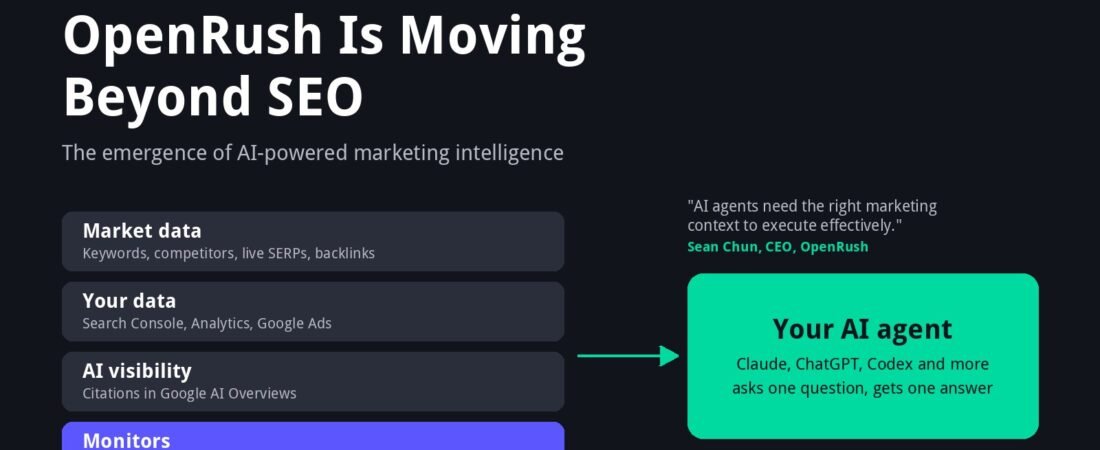
OpenRush started as an SEO data feed for AI agents. In 2026 it began reading your own Google data, measuring your presence in AI answers and, from November 16, watching your website over time. We tested the new features hands-on and asked OpenRush CEO Sean Chun where the company is heading. Here is why OpenRush is moving beyond SEO, what it costs, and what it means for the marketing software small businesses pay for every month.
CEO interview
Sean Chun
Tools tested
9
Test cost
$1.11
Monitors launch
Nov 16, 2026
Format
Reporting + opinion
In this article
- The Short Answer: Is OpenRush Moving Beyond SEO?
- Disclosure: How We Tested and What We Were Given
- What OpenRush Was: An SEO Data Layer for AI Agents
- What Changed in 2026: The Move Beyond SEO
- Why Agents Can Trust OpenRush Data: The Open Fact Envelope
- In Sean Chun's Words: OpenRush's CEO on Where It Is Heading
- Agent-First vs Dashboard-First: OpenRush, Semrush and Ahrefs Compared
- Hands-On: We Tested OpenRush's Beyond-SEO Features
- OpenRush Monitors Explained: The November 16 Launch
- The Economics: Credits vs Subscriptions
- What This Means for Traditional Marketing Software
- Analysis: Five Predictions for AI Marketing Software in 2027
- Who Benefits Most: Use Cases by Business Type
- 30 Prompts for Your Marketing Intelligence Layer
- Limitations and Open Questions
- How to Start Using OpenRush as a Marketing Intelligence Layer
- Our Verdict: OpenRush Has Become a Marketing Intelligence Layer
- Glossary: Key Terms Explained
- FAQ
- Sources
The Short Answer: Is OpenRush Moving Beyond SEO?
Yes. OpenRush started as an SEO data feed for AI agents: keywords, backlinks, live search results and site audits that tools like Claude and ChatGPT could pull on demand. In 2026 it has added connectors for Google Search Console, Google Analytics 4 and Google Ads, measurement of how often a site is cited in Google’s AI Overviews, a server-side backlink gap engine and, from November 16, 2026, a feature called Monitors that tracks a website over time. Together these turn OpenRush from an SEO data provider into what its CEO describes as the platform that gives AI agents “the right marketing context to execute effectively.”
That is a different product category from Semrush or Ahrefs. Those tools were built for people who log in and read dashboards. OpenRush is built for AI agents that ask questions and act on the answers, and it charges per question instead of per month.
We asked OpenRush CEO Sean Chun three questions for this article: how OpenRush fits next to Semrush and Ahrefs, what is next on the roadmap, and why the company chose credits over subscriptions. His full answers are below, alongside our own hands-on tests of the new features, the real cost of using them, and the limits small businesses should know before switching.
Key takeaways
- The shift: OpenRush now reads your own Google data (Search Console, Analytics, Ads) as well as public SEO data, so an AI agent can see what is actually happening on your site, not just estimates.
- The new feature: Monitors, launching November 16, 2026, re-run the same check on a schedule (site health, rankings, AI visibility, backlinks, competitors, Search Console, Analytics or Ads) and work out what changed.
- The pitch: Sean Chun calls Semrush and Ahrefs “adjacent competitors rather than direct ones” because OpenRush is “natively designed for agents first.”
- The price model: $10 buys 1,000 credits, credits never expire, and there is no subscription. Our full round of tests for this article cost 111 credits, or $1.11.
- The catch: you need an AI assistant to get value from it, third-party estimates still lag reality for small sites, and the three Google connectors are where most of the new value sits.
- Our view: for small businesses already working with AI assistants, OpenRush is now a credible replacement for a $129 to $199 a month SEO subscription. For teams that want polished dashboards and client reports, the incumbents still do that better.
Disclosure: How We Tested and What We Were Given
VeyronIQ is a paying OpenRush customer. While researching our original OpenRush review, OpenRush added 200 courtesy credits to our account. Nobody at OpenRush paid for this article, saw it before publication or asked to approve it.
Sean Chun’s comments come from an email exchange with VeyronIQ on November 12, 2026, after we told him we were writing about OpenRush’s move beyond SEO and asked if he would answer three questions. His answers are quoted exactly as written.
All test results come from our own OpenRush account on November 15, 2026. We ran nine different tools against veyroniq.com and a set of competitors in our category, starting with a balance of 841 credits and finishing with 730. Pricing for Semrush and Ahrefs comes from their own pricing pages, checked the same day.
How to read this article
This piece mixes reporting and analysis, the way a news desk would. Facts, figures and quotes are sourced and dated. Boxes marked Our take are VeyronIQ’s editorial opinion: what we think the facts mean, where we think OpenRush is strong or weak, and what we would do in your position. You are free to disagree with our opinions; the facts underneath them are there so you can check.
What OpenRush Was: An SEO Data Layer for AI Agents
To understand where OpenRush is going, it helps to remember where it started.
When we first reviewed OpenRush, it was best described as a marketing data layer for AI agents. Instead of logging into a dashboard, you connected OpenRush to an AI assistant such as Claude or ChatGPT through the Model Context Protocol (MCP), the open standard that lets AI assistants use outside tools. Once connected, you could ask a normal question, such as “Who are my search competitors?”, and the assistant would call OpenRush, get structured data back and explain the answer.
The data itself was classic SEO data:
- Keyword research: search volume, cost per click, competition and intent for any term.
- Domain overviews: a site’s estimated organic traffic, top keywords and top pages.
- Competitor discovery: which sites rank for the same terms.
- Live search results: what Google shows right now for a query.
- Backlinks: who links to a site and how strong those links are.
- Site audits: technical and content problems on your pages.
OpenRush says this data covers about 8 billion keywords and 1.3 billion websites, refreshed daily. Its homepage claims more than 40,000 users.
What made OpenRush different was not the data. Semrush and Ahrefs have deep data too. It was the delivery. Every response came back in the same structured format, which OpenRush calls the Open Fact Envelope. Each fact carries its own source, confidence score and timestamp, so an AI agent can tell the difference between a live Google result and an estimate from a search index. That sounds technical, but it matters: it is what stops an AI assistant from presenting a guess as a fact.
In our original review we scored OpenRush 7.5 out of 10. We liked the agent-first design and the pay-per-use pricing. The biggest problem was that the full site audit failed on our site. OpenRush fixed it, and when we re-ran the OpenRush site audit on November 12, 2026, it worked on every run and our on-page score went from 90.9 to 99.4.
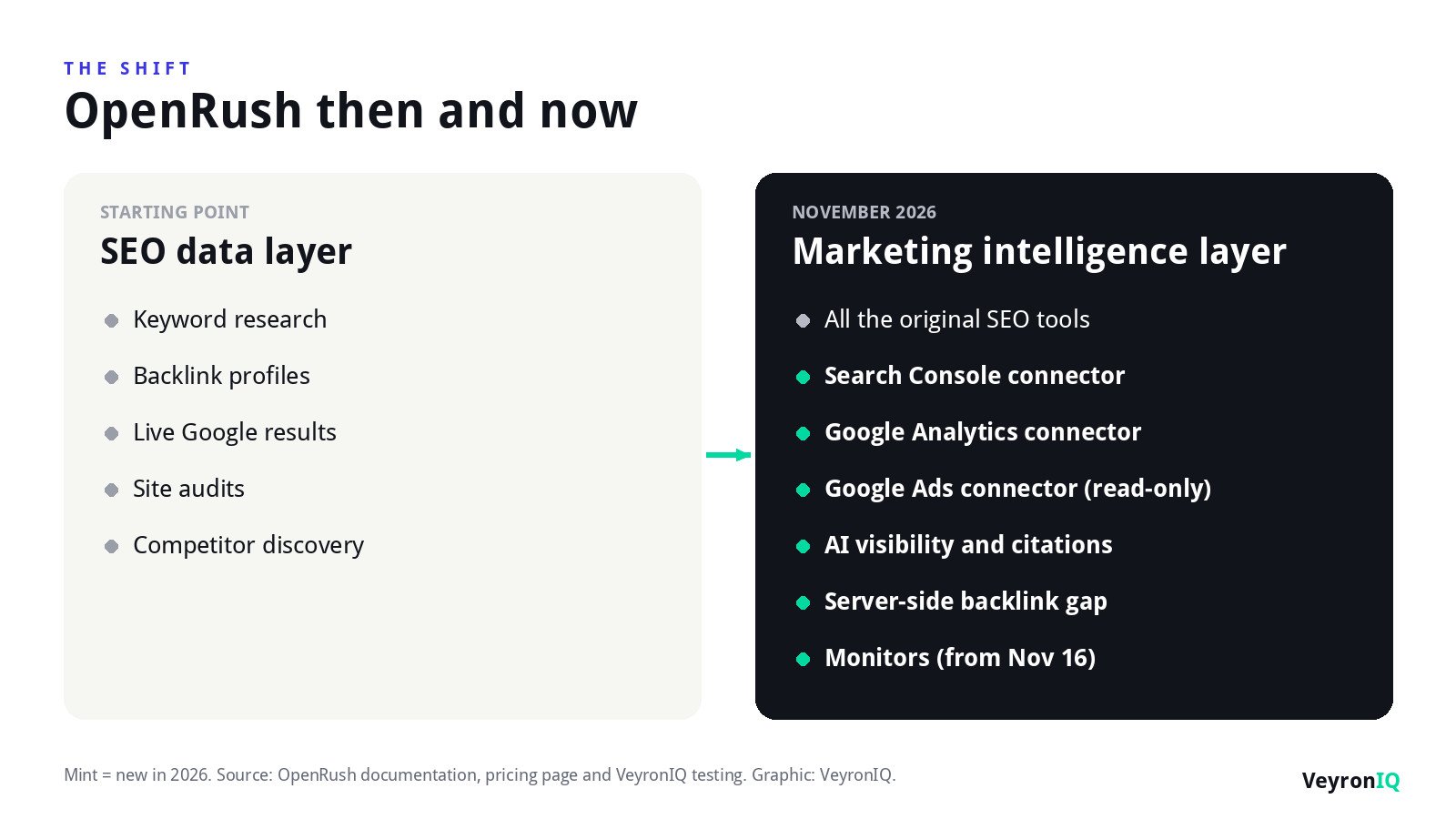
OpenRush’s feature set at launch compared with November 2026. New capabilities are highlighted in mint. Graphic: VeyronIQ.
What Changed in 2026: The Move Beyond SEO
Over the past few months, OpenRush has added capabilities that have little to do with traditional SEO research. The clearest sign of the shift is on Google itself. When we checked the live results for “openrush” on November 15, 2026, OpenRush’s own homepage title read “Google Search Console MCP for AI Agents,” and its description promised: “Ask your agent about your own search traffic and get an answer, not a spreadsheet.”
That is a company describing itself by your data, not its data.
Here is what OpenRush now covers, grouped by what each piece is for.
| Capability | What it does | Data source | Credits per call |
|---|---|---|---|
| Search Console connector | Your real clicks, impressions, click-through rate and average position | Your Google Search Console | 2 |
| Google Analytics connector | Your real sessions, users, engagement and traffic sources | Your GA4 property | 2 |
| Google Ads connector | Spend, clicks, conversions and return on ad spend, plus campaign settings, keywords and ad copy | Your Google Ads account | 2 each |
| AI visibility | How often your domain is cited in Google AI Overviews, compared with up to nine competitors | Sampled AI answers | 20 |
| AI citations | Which domains Google’s AI Overviews cite most in your category | Sampled AI answers | 22 |
| Backlink gap | Sites that link to several competitors but not to you, filtered for spam and ranked | Backlink index | 40 |
| Monitors | Re-runs any of the checks above on a schedule and reports what changed | All of the above | Same as the tool it runs |
| Classic SEO tools | Keywords, domains, competitors, live search results, audits, backlinks | Search index and live results | 2 to 12 |
Credit costs come from OpenRush’s pricing page. One credit costs $0.01.
The pattern is clear. The original tools answered “what is happening in the market?” The new tools answer “what is happening to my business?” and “where should I show up next?” That second set of questions is what marketing teams actually spend their week on, and it is where agencies and subscription tools have traditionally charged the most.
What is a marketing intelligence layer?
A marketing intelligence layer is a single place that combines market data (what competitors and customers are doing) with your own performance data (what your website, search traffic and ads are doing), in a form that software can read and act on. Instead of a person switching between Search Console, Google Analytics, Google Ads and an SEO tool, an AI agent asks one layer and gets one consistent answer with sources attached.
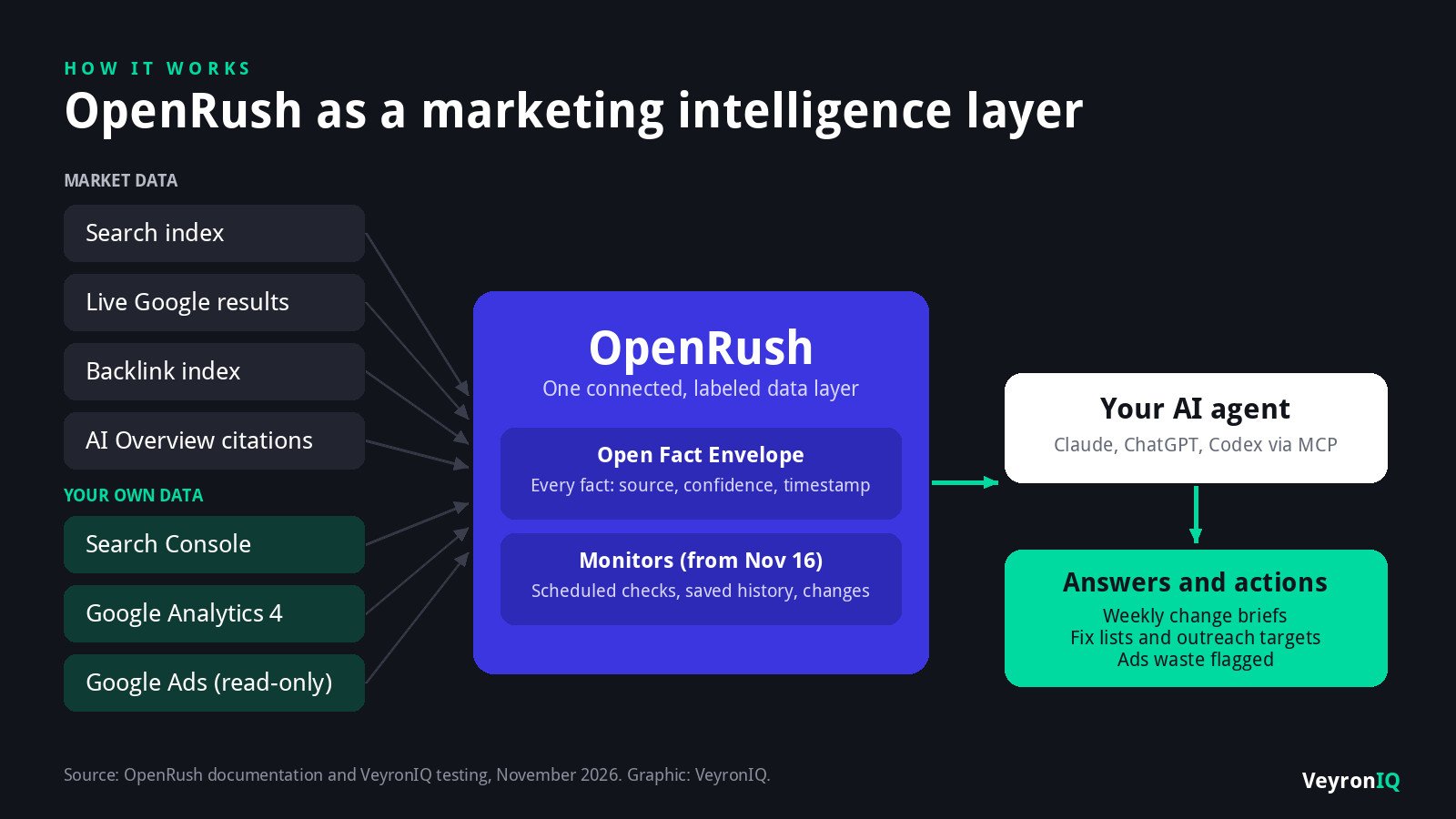
How the pieces fit together: market data and your own Google data flow through OpenRush to your AI agent, which turns them into answers and actions. Graphic: VeyronIQ.
Why owned data changes everything for small sites
There is a simple reason the Google connectors matter so much, and our own tests showed it clearly.
When we asked OpenRush’s search index about veyroniq.com, it estimated that our site ranks for 5 keywords and gets about 1 organic visit a month. Our own Google Search Console tells a very different story: over the previous three months we earned 2,470 impressions and 24 clicks, with an average position of 17.7.
Neither number is wrong. Third-party SEO indexes, including Semrush’s and Ahrefs’, are built by sampling the web. They are excellent for large sites and for comparing competitors, but they routinely miss the long tail of small sites. OpenRush is upfront about this: its response warned that “the median candidate here indexes 206 keywords, 41x this target’s 5” and that overlap rankings would be unreliable at that gap.
That is the core argument for connecting your own data. An estimate can tell you roughly where you stand against competitors. Only Search Console can tell you which real searches brought real people to your pages last week. By putting both behind the same agent, OpenRush lets you use each for what it is good at.
Our take · VeyronIQ opinion
The smartest bet OpenRush has made
Third-party SEO data is slowly becoming a commodity. Every major suite builds or licenses a similar web index, and the numbers for small sites are rough everywhere. Your own Search Console, Analytics and Ads data is not a commodity: it is the one thing an AI agent cannot estimate. By building around owned data, OpenRush has picked the part of the market that is hardest for a generic chatbot to fake.
We would add one caution. Google hands the same data to anyone through free APIs, so the data itself is not a moat. The advantage is in how cleanly it is joined to market data and how much an agent can trust the result. That is a real edge, but a narrow one, and the incumbents will chase it.
Why Agents Can Trust OpenRush Data: The Open Fact Envelope
One reason OpenRush works well as an intelligence layer is easy to miss, because you never see it unless you look at the raw responses. Every OpenRush tool returns data in the same structure, which OpenRush calls the Open Fact Envelope. We looked closely at the responses from our tests to see what it contains.
Each response includes:
- The data itself, in a compact form an agent can read quickly.
- Facts, each tagged with a type such as “AI visibility brand mentions” or “backlink gap.”
- Provenance for every fact: where it came from (for example, a live Google result, the search index, the backlink index, a site crawl or your own Search Console), how it was gathered, a confidence score from 0 to 1, the exact time it was observed and whether it came from a cache.
- Entities, the domains, pages and keywords the facts are about, each with a stable identifier so separate results can be linked together.
- Coverage, a plain statement of what the result does and does not cover.
- Next actions, suggested follow-up tool calls.
Here is why that matters in practice. In our tests, a live Google result came back with a confidence score of 0.95. Search index estimates came back at 0.7. Our zero AI citations came back at 0.4, because a small domain with no citations is genuinely uncertain. A well-built agent can use those scores to decide how strongly to state a conclusion: “Google shows this right now” versus “estimates suggest” versus “we can’t tell yet.”
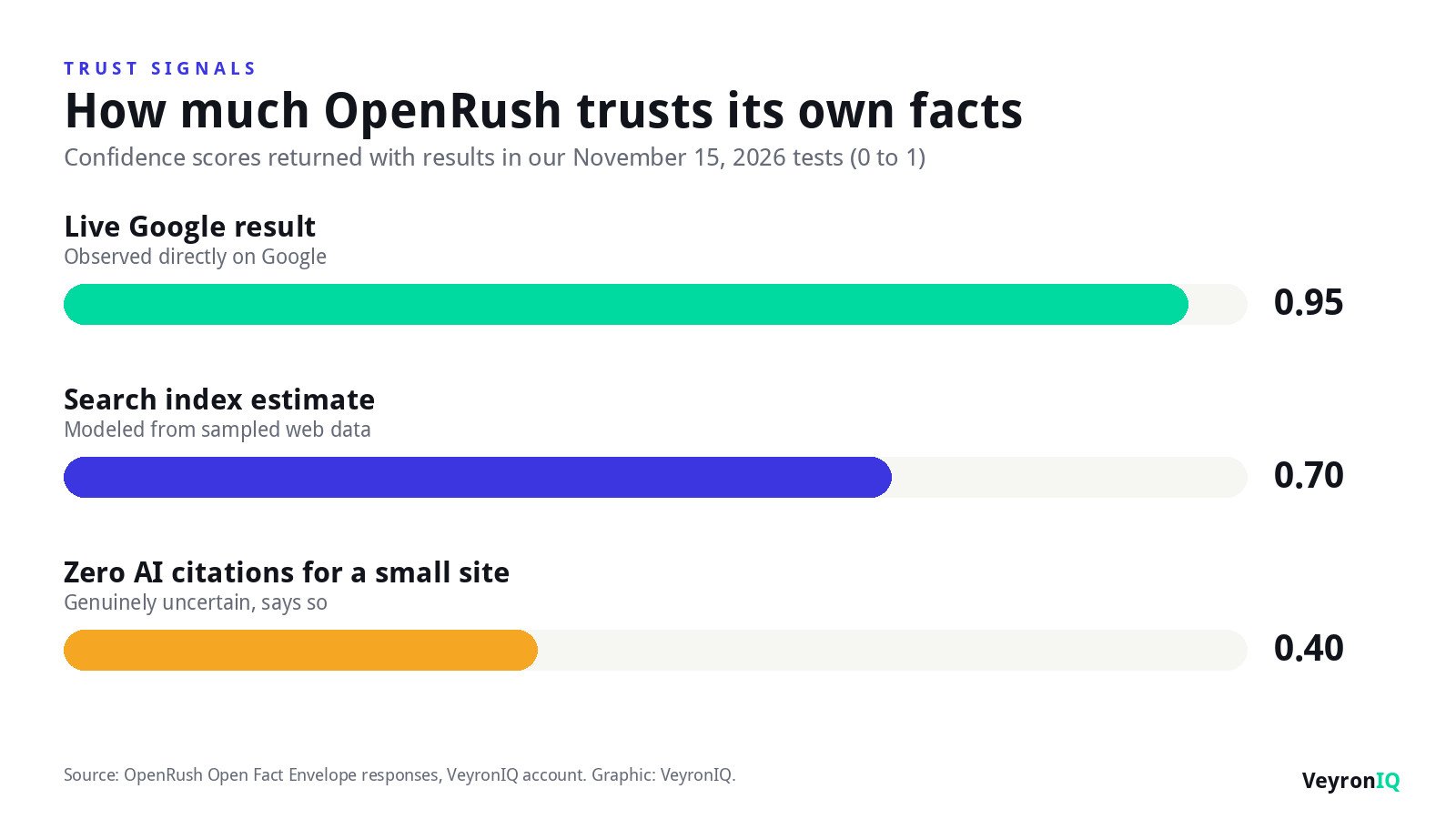
Confidence scores OpenRush attached to three of our test results. Higher means the fact was observed directly rather than estimated. Graphic: VeyronIQ.
The coverage notes are equally useful. Our AI visibility result stated that it “covers Google AI Overview only, not ChatGPT, Claude, Gemini, Perplexity, or CoPilot,” and that “small and new brands may legitimately show zero.” Our backlink gap result explained that two competitor lists “hit the 1000-row depth cap.” That is the kind of honesty that usually lives in a help article nobody reads. Here it travels with the data, so the agent can pass it on.
For small businesses, the benefit is fewer confident-sounding wrong answers. The biggest risk of using AI for marketing decisions is an assistant presenting an estimate as fact. A data layer that labels every fact with its source and confidence is a practical defense against that.
Our take · VeyronIQ opinion
The most underrated feature in the product
Nobody will buy OpenRush for its response format, but it may be the main reason to trust it. The biggest problem with AI in marketing is not that it is slow or expensive; it is that it sounds equally confident when it is right and when it is guessing. Attaching a source and a confidence score to every fact is a practical fix, and we would like to see every marketing data vendor copy it.
Our one wish: that this honesty reaches the business owner, not just the agent. The scores only help if your assistant passes them on in plain language, so we recommend telling your agent to say how sure it is whenever it quotes an OpenRush number.
In Sean Chun’s Words: OpenRush’s CEO on Where It Is Heading
When we told Sean Chun, OpenRush’s CEO, that we were writing about OpenRush becoming a marketing intelligence layer rather than an SEO tool, his first reply was short: “I love it! You are spot on with the direction of OpenRush.”
He then summed up the company’s thesis in two sentences:
“AI agents need the right marketing context to execute effectively and create winning results, which requires a simple platform to connect the right data and provide the intelligence needed to win.”
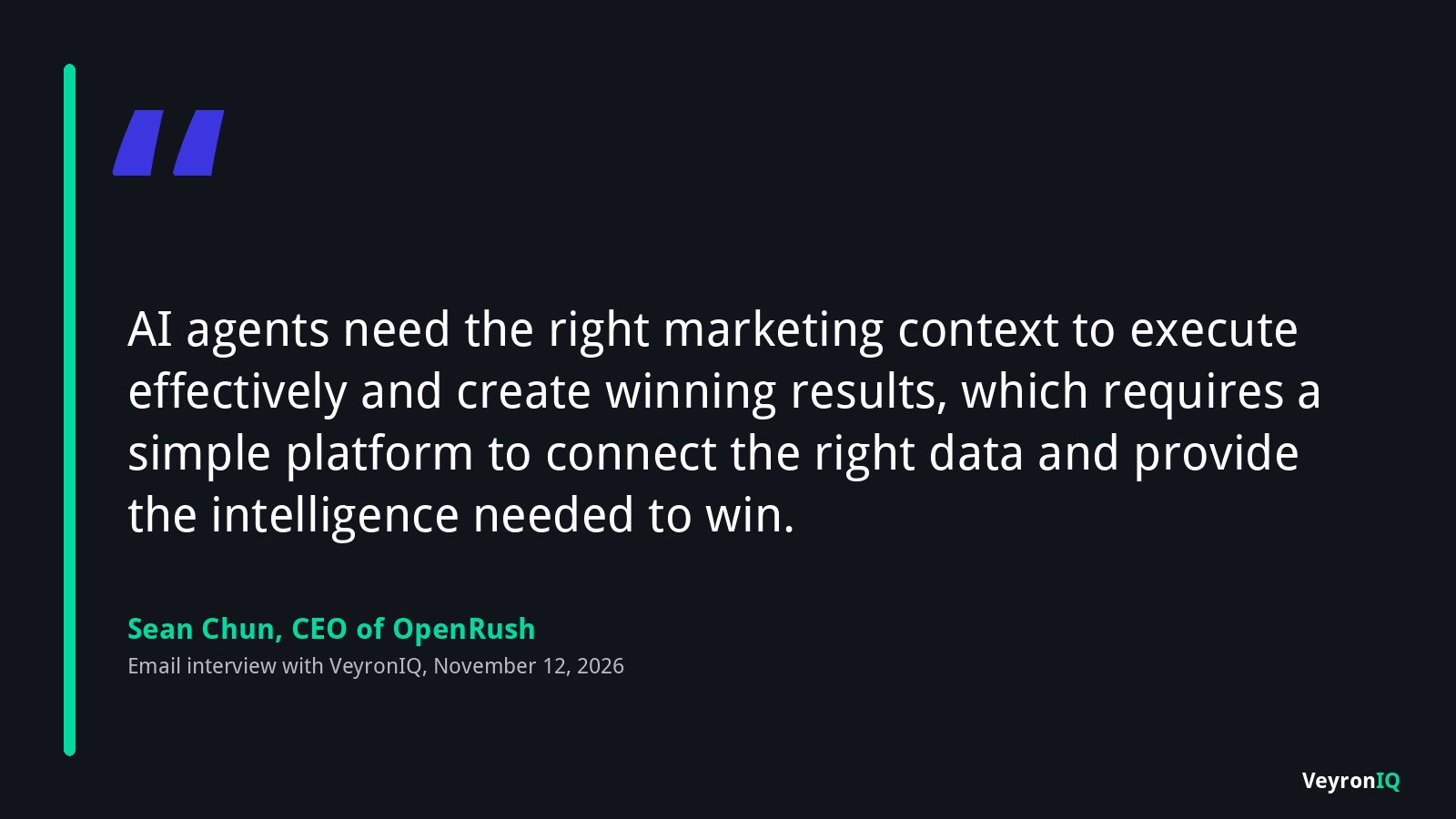
Sean Chun’s summary of OpenRush’s thesis, from his November 12, 2026 email to VeyronIQ. Graphic: VeyronIQ.
That framing is worth unpacking, because it explains almost every product decision OpenRush has made this year. An AI agent is only as good as what it knows. Ask a general AI assistant why your traffic dropped and, without data, it can only guess. Give it your Search Console numbers, your competitors’ rankings and the current search results, and it can actually investigate. OpenRush’s bet is that the valuable part of marketing software is no longer the dashboard. It is the context: the right data, connected, cleaned and labeled so an agent can trust it.
We asked Chun three specific questions. Here are his answers in full, with our analysis of each.
Question 1: How does OpenRush fit next to Semrush and Ahrefs?
“We see Semrush and Ahrefs as adjacent competitors rather than direct ones. They are established SEO players that built products around a human-centric experience with complex dashboards and UI. OpenRush is natively designed for agents first—every aspect of our product is carefully crafted to help agents handle marketing tasks better. We eliminate the need for multiple open tabs because you can get the answer you need with a single prompt.”
Our analysis. This is the most interesting claim in the interview, because on the surface it sounds like positioning, and in practice it holds up better than you might expect.
The phrase that matters is “human-centric experience.” Semrush and Ahrefs were designed around a person sitting in front of a screen: you open a report, apply filters, export a spreadsheet and draw conclusions. Even their excellent data is shaped for that workflow. OpenRush has no meaningful dashboard for research at all. Its “interface” is the conversation with your AI assistant.
You can see the difference in the small details we noticed while testing:
- Every result explains its own limits. When our domain was too small for reliable competitor matching, the response said so and suggested a better method. A dashboard shows you a number; OpenRush told the agent how much to trust it.
- Every result suggests the next step. Responses include a list of follow-up tool calls, so an agent naturally moves from “who are my competitors?” to “what links do they have that I don’t?” without being told.
- Heavy work happens on the server. The backlink gap tool pulled nearly 3,000 referring domains from five competitors, removed spam and duplicates and returned a ranked list of 120, all in one call. Doing that in a traditional tool means several exports and a spreadsheet.
The “single prompt” line is also fair, with one caveat. A single prompt can trigger several tool calls behind the scenes, each costing credits. In our tests, the AI did most of the stitching together. That is the point of the design, and it worked, but it means you are trusting the agent to ask good questions.
Where the claim is weaker. Semrush and Ahrefs are not standing still. Semrush’s pricing page now sells an “SEO + AI Search” plan that includes MCP access, and promotes a Semrush MCP server that brings its data “inside your AI assistants.” Ahrefs offers an SEO MCP and API access, an AI assistant called Ask Ahrefs, and promotes Letaido, an AI marketing product built on its own web index. The incumbents have clearly seen the same shift. The real question is not whether they can serve agents, but whether a product built around dashboards and monthly seats can become agent-first as cleanly as one that started there. That is the bet OpenRush is making.
Question 2: What is next on the roadmap?
“On Monday, November 16, we are launching a new feature called Monitors. Your agent can set up powerful monitors to continually track the work you’ve been doing. Instead of starting fresh each week, your agent can access a history of past data points to see how your website is trending and what you need to do to win.”
Our analysis. Monitors solve the single biggest weakness of agent-based marketing tools: memory.
Until now, every conversation with an AI agent started from zero. You could ask it to audit your site on Monday and again the following Monday, but it had no reliable way to compare the two. You either kept your own spreadsheet or asked the agent to re-pull everything and hope it remembered the old numbers correctly. Traditional SEO tools have always had an advantage here, because tracking over time is what dashboards and rank trackers are built for.
Monitors close that gap. OpenRush runs the check on its own servers on a schedule, saves every result, and works out what changed. Your agent then reads the history and explains it. In Chun’s words, you no longer start “fresh each week.” We cover exactly how Monitors work, what they cost and what they can track in the Monitors section below.
This is also the feature that most clearly moves OpenRush beyond SEO. A tool that answers questions is a research assistant. A tool that watches your business continuously and tells you what changed is closer to a marketing analyst.
Question 3: Why usage-based credits instead of subscriptions?
“We believe the future of agentic software shouldn’t live behind a subscription paywall. Traditional subscription models are based on human usage patterns and often trap users into recurring fees for features they don’t use. A usage-based system allows agents to maximize our platform efficiently. You should pay for how much you actually use the platform, not an arbitrary recurring fee. Our credits never expire, so users can always pick up right where they left off.”
Our analysis. The phrase “based on human usage patterns” is the key insight here.
Subscriptions made sense when software was used by people. A person logs in a few times a week, uses a handful of reports, and a monthly fee roughly matches that rhythm. Agents use software very differently. An agent might make 50 calls in ten minutes while researching a new market, then nothing for two weeks. A flat monthly fee overcharges the quiet months and, with usage caps, can block the busy ones.
Pay-per-call pricing matches how agents actually work. It also has a quieter benefit for small businesses: no seat fees. Semrush charges from $45 a month for each additional user and Ahrefs from $40. OpenRush has no seats at all; your whole team, and any number of agents, draw from one credit balance.
The “credits never expire” point matters more than it sounds. Many usage-based tools expire unused credits monthly, which quietly turns them back into subscriptions. Non-expiring credits mean a seasonal business can load $50 in spring and still have it in autumn.
We test whether the economics actually work out cheaper in the cost section below. Short version: for most small businesses, by a wide margin.
Our take · VeyronIQ opinion
On the interview
Chun’s answers are confident, and more importantly they match what the product actually does. That is not always true of startup founders, and it made our fact-checking easier: every claim he made about Monitors and credits lined up with OpenRush’s own documentation and with what we saw in our account.
The question our three did not cover, and the one we would put to him next, is distribution. Semrush and Ahrefs have millions of users and are already selling MCP access. If they decide to make agent access cheap, OpenRush’s price advantage narrows quickly, and it will need to win on product alone. We think it can win that argument with small businesses that already live inside AI assistants. Winning it with everyone else is a much harder sell.
Agent-First vs Dashboard-First: OpenRush, Semrush and Ahrefs Compared
Chun describes Semrush and Ahrefs as adjacent rather than direct competitors. For a small business deciding where to spend money, they still compete for the same budget, so here is how they compare on the things that matter. Prices are from each company’s own pricing page on November 15, 2026.
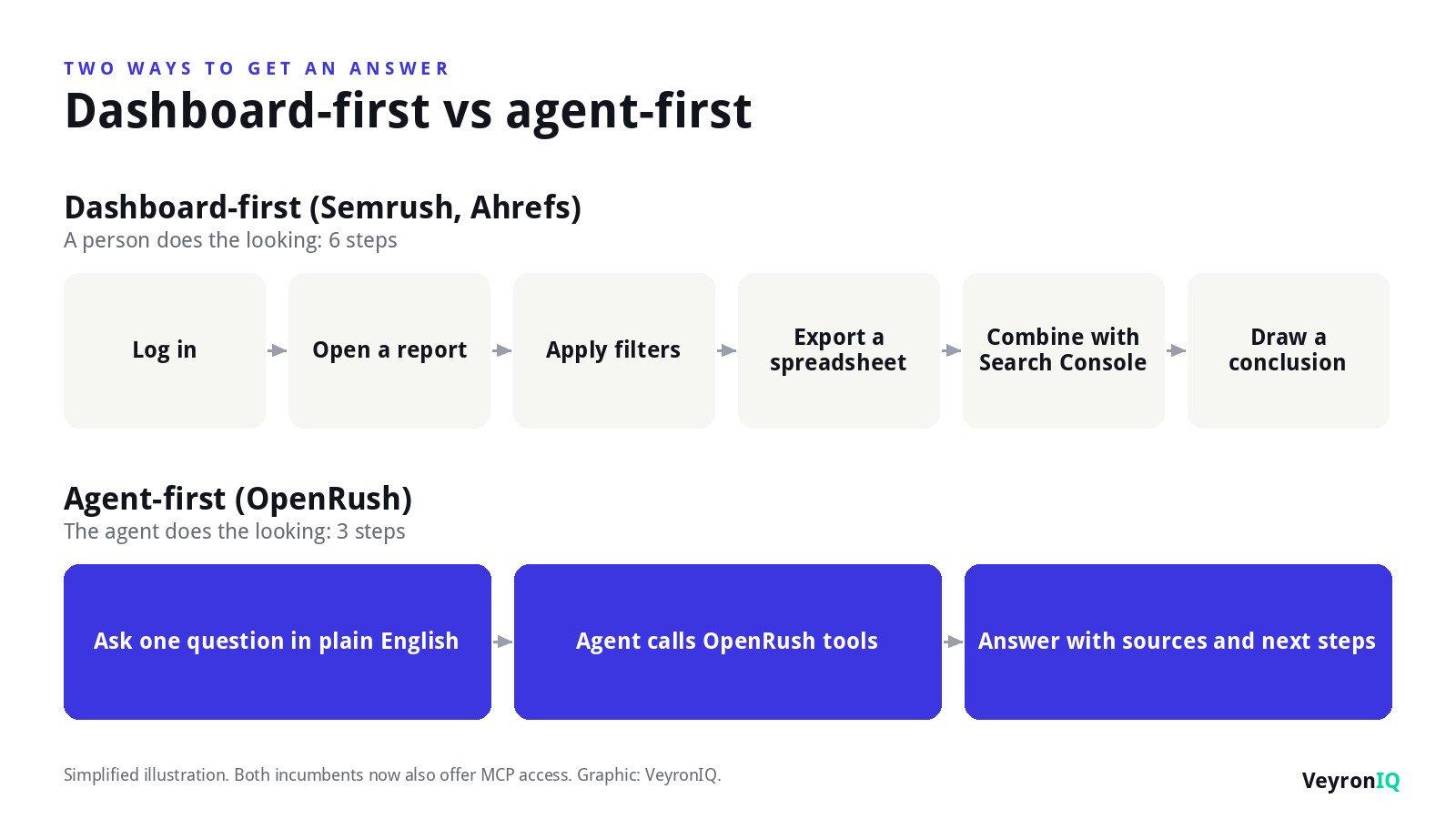
A simplified view of how the same question gets answered in a dashboard-first tool and in an agent-first tool. Graphic: VeyronIQ.
| OpenRush | Semrush | Ahrefs | |
|---|---|---|---|
| Built for | AI agents first | People using dashboards, now adding AI | People using dashboards, now adding AI |
| How you use it | Ask questions in Claude, ChatGPT or another agent | Web app, plus MCP and API | Web app, plus MCP and API |
| Entry price | Free to start, then $10 per 1,000 credits | $139 a month for the SEO plan ($117.33 billed annually) | $129 a month for Lite |
| AI search plan | Included, pay per call | SEO + AI Search from $199 a month ($165.17 billed annually) | Brand Radar AI from $199 a month |
| Extra users | No seat fees | From $45 a month per user | From $40 a month per user |
| Unused allowance | Credits never expire | Monthly limits reset | Monthly limits reset |
| Your Search Console data | Yes, through the agent | Yes, inside the app | Yes, GSC Insights |
| Your Google Ads data | Yes, read-only, including campaign settings and ad copy | Advertising toolkit sold separately | PPC research tools |
| Tracking over time | Monitors, from Nov 16, 2026 | Mature rank tracking and reports | Mature rank tracking and reports |
| Client-ready reports | No; your agent writes them | Yes, polished and scheduled | Yes, Report Builder add-on |
| Rate limits | 60 per minute, 1,000 per hour, 10,000 per day | Plan-based report limits | Plan-based credits |
Where OpenRush wins
- Cost for light and medium use. Most small businesses use an SEO tool a few hours a month. Paying per call is dramatically cheaper than a subscription in that case.
- Owned data inside the agent. Being able to ask “which pages lost clicks this quarter and what do competitors rank for on those topics?” in one conversation, combining Search Console with market data, is genuinely new for a tool at this price.
- Read-only Google Ads analysis. OpenRush can read campaign settings, keywords, search terms and ad copy, not just spend. For a small business running its own ads, that turns an agent into a second pair of eyes on wasted spend.
- No lock-in. No annual contract, no seats and no expiring credits.
Where Semrush and Ahrefs still win
- Depth and history. Both have years of historical data, huge keyword databases and mature rank tracking. Monitors start their history from the day you create them.
- Visual reporting. If you send monthly reports to clients or a boss, the incumbents produce polished, branded reports automatically. With OpenRush, your agent writes the report, which is flexible but less standardized.
- No AI assistant required. OpenRush is almost unusable without an agent. If your team does not use Claude, ChatGPT or similar tools, a traditional dashboard is simpler.
- Wider toolsets. Both offer content writing tools, local SEO, social media management and more. OpenRush is focused on data and analysis.
Our take · VeyronIQ opinion
Which one we would choose
If we were starting a small business today and already used Claude or ChatGPT every day, we would start with OpenRush and only add a Semrush or Ahrefs subscription when we hit a specific wall, such as needing years of ranking history or branded client reports. That order matters: it is far easier to add a subscription later than to justify cancelling one you have built habits around.
For an agency whose clients expect polished monthly PDFs, we would do the opposite: keep the incumbent and run OpenRush alongside it for research and monitoring, where it is cheaper and faster. For most readers, this is less of an either-or decision than the marketing on both sides suggests.
Hands-On: We Tested OpenRush’s Beyond-SEO Features
Claims are easy. To see whether OpenRush really works as a marketing intelligence layer, we spent an afternoon using it the way a small business owner would: asking our AI assistant practical questions about our own site, veyroniq.com, and letting it call OpenRush to answer them.
We ran nine tools in total. Here is what each one told us, what it cost, and where it fell short.
| Test | Tool | Credits | Cost |
|---|---|---|---|
| Who does AI cite in our category? | AI citations | 22 | $0.22 |
| Are we cited in AI answers vs competitors? | AI visibility | 20 | $0.20 |
| Who are our real competitors? | Competitor discovery | 7 | $0.07 |
| What links do competitors have that we don’t? | Backlink gap | 40 | $0.40 |
| What does OpenRush’s index say about our site? | Domain overview | 9 | $0.09 |
| What does Google show for “openrush” right now? | Live search results | 2 | $0.02 |
| What do people search for around AI marketing? | Keyword research (twice) | 6 | $0.06 |
| How in-demand is “semrush alternative”? | Keyword lookup | 5 | $0.05 |
| Total | 9 tools | 111 | $1.11 |
Our balance went from 841 credits to 730. For context, a single month of the cheapest Semrush or Ahrefs plan would buy more than 12,000 OpenRush credits, enough to repeat this entire research session more than 100 times.
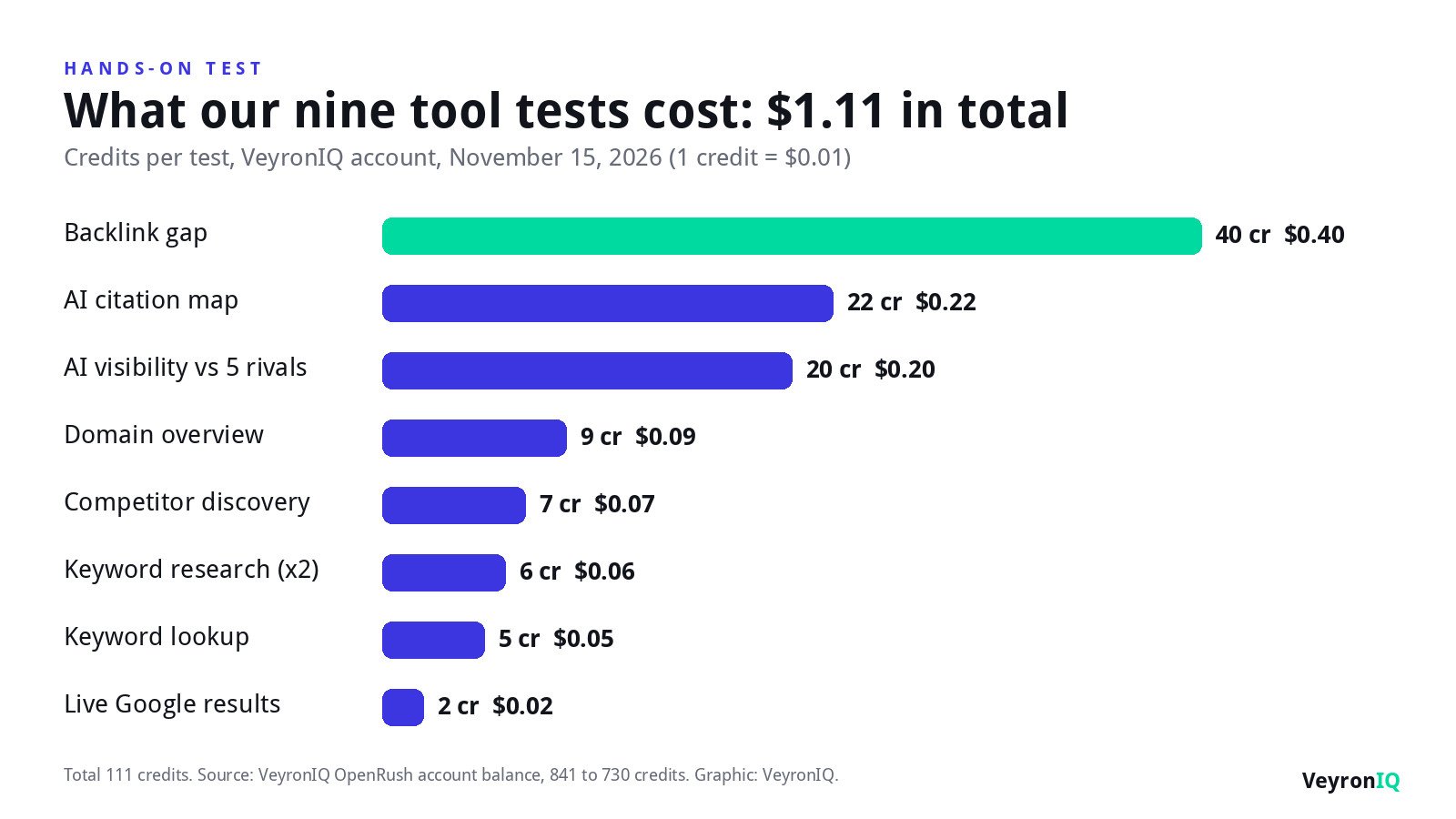
Credits used by each of our OpenRush tests on November 15, 2026. The whole session cost $1.11. Graphic: VeyronIQ.
Test 1: Who does Google’s AI cite for “AI tools for small business”?
This is one of the new AI visibility tools, and for a site like ours it was the most eye-opening result of the day.
We asked which sources Google’s AI Overviews cite most when answering questions about AI tools for small businesses. OpenRush returned a ranked map of the 20 most-cited domains, built from a sampled set of AI answers:
| Rank | Domain | Citations | Share |
|---|---|---|---|
| 1 | youtube.com | 19,712 | 36.4% |
| 2 | reddit.com | 8,448 | 15.6% |
| 3 | linkedin.com | 2,432 | 4.5% |
| 4 | zapier.com | 2,240 | 4.1% |
| 5 | wix.com | 2,048 | 3.8% |
| 6 | forbes.com | 1,856 | 3.4% |
| 7 | en.wikipedia.org | 1,856 | 3.4% |
| 8 | canva.com | 1,600 | 3.0% |
| 9 | facebook.com | 1,600 | 3.0% |
| 10 | salesforce.com | 1,536 | 2.8% |
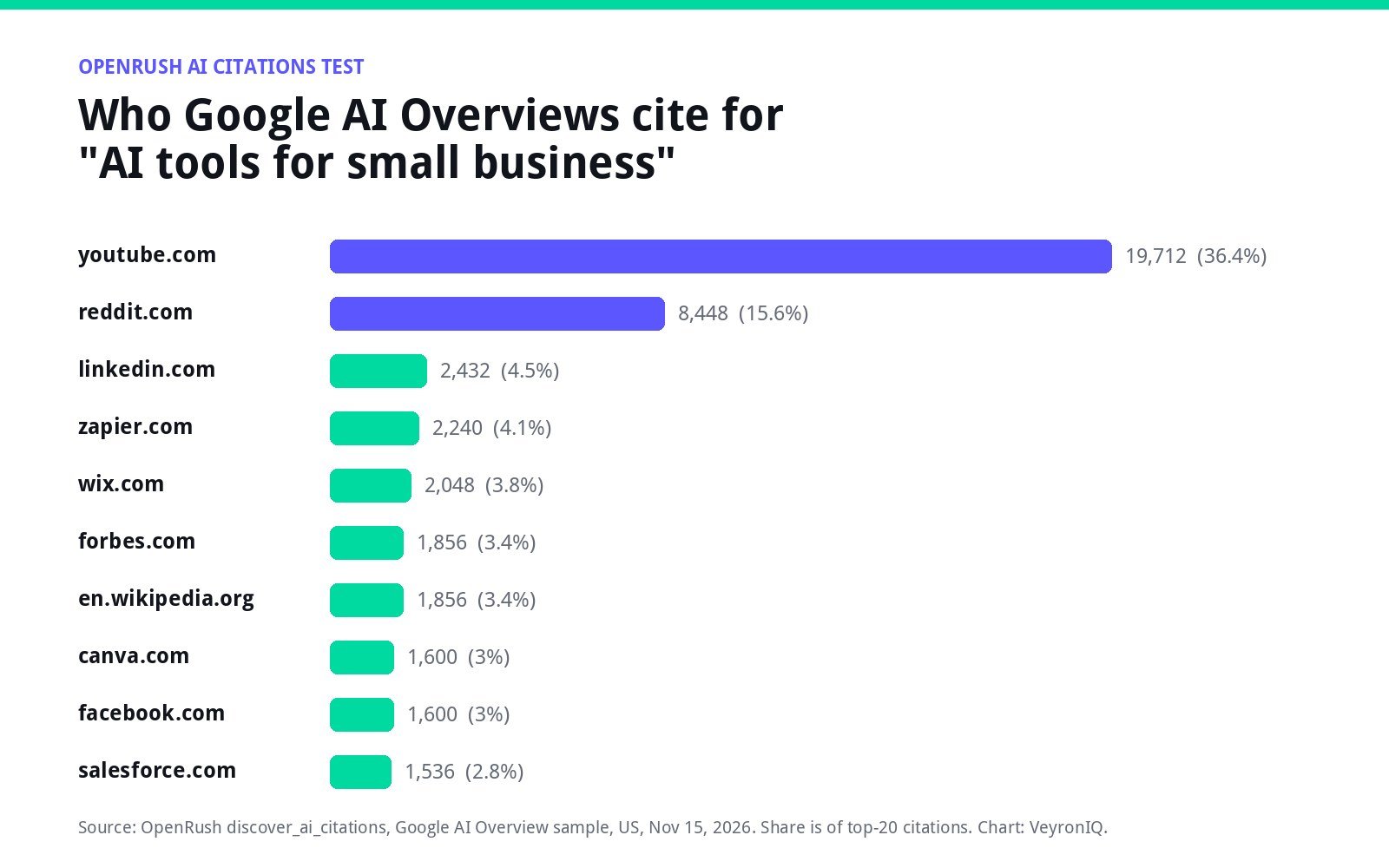
The ten domains Google AI Overviews cite most for “AI tools for small business,” from our OpenRush test on November 15, 2026. Chart: VeyronIQ.
What it told us. More than half of all citations in our category go to just two platforms: YouTube and Reddit. That is a practical, actionable finding. If a small business wants to appear in Google’s AI answers for its category, publishing helpful videos and taking part in genuine Reddit discussions may matter as much as its own website. Review sites such as G2 (rank 13) and publishers such as Forbes and PCMag also appear, which suggests that being reviewed and mentioned elsewhere feeds directly into AI visibility.
What it cost. 22 credits, or $0.22.
Limits. OpenRush is careful to say this covers Google AI Overviews only, not ChatGPT, Claude, Gemini, Perplexity or Copilot. It measures domains cited as sources, not every time a brand is discussed, and it is based on a sample of AI answers rather than what any individual user sees.
Test 2: Is VeyronIQ cited in AI answers compared with competitors?
Next we compared our own AI visibility with five sites OpenRush identified as competitors for our core searches.
| Domain | AI Overview citations | Share of the group |
|---|---|---|
| eesel.ai | 5,138 | 89.1% |
| hackceleration.com | 313 | 5.4% |
| revoyant.com | 173 | 3.0% |
| unite.ai | 142 | 2.5% |
| veyroniq.com | 0 | 0% |
| aistackverdict.com | 0 | 0% |
What it told us. Google’s AI Overviews do not cite VeyronIQ yet. That was not a surprise for a young site, but having a number makes it measurable, and OpenRush treats a zero as a real answer rather than an error. Its response pointed straight to the AI citations tool so we could see where to earn mentions, which is exactly the result from Test 1.
It also revealed how concentrated AI citations are. One competitor holds 89% of the group’s citations. That is the kind of pattern that is invisible in traditional SEO reports, which focus on rankings rather than citations.
What it cost. 20 credits for all six domains at once. Adding competitors costs nothing extra because they are batched into a single call.
Why this matters beyond SEO. Ranking on page one of Google and being quoted in an AI answer are increasingly different things. A business can rank well and still be invisible in AI Overviews, or the reverse. Measuring both is part of what makes OpenRush a marketing intelligence layer rather than a rank tracker.
Test 3: Finding our real competitors
When we asked OpenRush’s index for competitors based on our domain alone, the results were weak. Because the index only knew about 5 of our keywords, it suggested sites that happened to share one search term, such as sites with similar names.
OpenRush flagged this itself and recommended switching to “seed keyword” mode, which looks at who consistently ranks for a list of real searches instead. We gave it six searches that describe what we do, including “ai tools for small business,” “openrush review” and “notion ai review.” This time the results made sense: Trustpilot and G2 (review platforms), followed by AI tool review sites such as eesel.ai, hackceleration.com, cybernews.com and unite.ai.
What it told us. Our true competitive set is review platforms and independent AI review sites, not general marketing blogs. That shaped every test that followed.
What it cost. 7 credits.
The lesson for small businesses. If you are a small or new site, describe your business with real search terms rather than relying on domain-based tools. OpenRush’s habit of explaining when its own data is unreliable is one of its most underrated features.
Test 4: The backlink gap
The backlink gap is one of the tools Chun’s team has been improving, and it shows the “server-side intelligence” idea at its best.
We asked for sites that link to several of our competitors but not to us. In one call, OpenRush:
- Ranked our five competitors by real authority.
- Pulled their referring domains: 2,903 unique sites in total.
- Found 291 that link to at least two competitors.
- Removed 140 spammy domains, 31 low-authority domains and 2 hosting platforms.
- Returned 120 qualified domains: 115 genuine gaps and 5 we had already earned, including dev.to.
The top of the list included noah-news.com and shouldiuse.io (each linking to four of our five competitors), accio.com, fast.io, techyorker.com, startupintros.com and beehiiv.com.
What it told us. We now have a ranked outreach list of 115 sites that already link to sites like ours. Several are directories and AI tool listings, which are some of the easiest links to earn. The tool also flags links we already have, so we do not waste time pitching sites that already link to us.
What it cost. 40 credits, or $0.40. It is OpenRush’s most expensive tool, and in our view the best value, because doing this by hand takes hours of exports and spreadsheet work.
Limits. For the two biggest competitors, OpenRush pulled their top 1,000 referring domains out of 13,047 and 4,451 respectively. It says this recovers “essentially the full intersect,” which is reasonable for finding the strongest shared links, but it is not an exhaustive crawl.
Test 5: The search index vs reality
We covered this earlier, but it deserves its own line in the results. OpenRush’s domain overview estimated that veyroniq.com ranks for 5 keywords and gets about 1 organic visit a month. Google Search Console shows 2,470 impressions and 24 clicks over three months.
What it told us. For small sites, third-party estimates are a starting point, not the truth. This is true of every SEO tool, not just OpenRush. The difference is that OpenRush now lets you plug in Search Console so your agent can work from measured data, and it told us plainly when its estimate was thin.
What it cost. 9 credits.
Test 6: What Google shows right now
A live search snapshot for “openrush” returned the top results, the AI Overview text and its sources, and which search features were present (AI Overview, videos, images and related searches).
What it told us. Two things. First, OpenRush’s homepage now leads with Search Console for AI agents, which supports the thesis of this article. Second, OpenRush has a naming problem: the results also included an unrelated open-source project called “open-rush” for running Claude Code agents, and a GitHub project describing itself as “a Semrush open-source alternative” under the same name. For a growing brand, that confusion is worth fixing.
Google’s AI Overview described OpenRush as “a marketing data layer and Model Context Protocol (MCP) server built to give AI agents (like Claude and ChatGPT) live access to SEO, keyword, backlink, and competitor intelligence,” citing OpenRush’s own site, Capterra and a third-party setup guide.
What it cost. 2 credits.
Test 7: Keyword research, two ways
We asked for keyword ideas around “ai marketing tools.” In the default “ideas” mode, the results were too broad to be useful: generic terms such as “digital marketing” and “social media,” plus several misspellings such as “ditital marketing” and “socail media marketing.” In “suggestions” mode, the results were sharp:
| Keyword | Monthly searches (US) | Cost per click | Competition |
|---|---|---|---|
| ai marketing tools | 3,600 | $39.12 | Low |
| ai tools for marketing | 3,600 | $39.12 | Low |
| ai powered marketing tools | 720 | $8.08 | Low |
| best ai marketing tools | 390 | $39.80 | Low |
| ai marketing tools for small business | 260 | $48.88 | Medium |
| ai marketing automation tools | 260 | $49.04 | Low |
What it told us. Commercial AI marketing searches are valuable: advertisers pay around $39 to $49 per click. For a content site, ranking for these terms organically is worth a lot.
What it cost. 3 credits per run.
Limits. The “ideas” mode needs better filtering. An experienced user will switch modes; a new user, or an agent that does not know better, may get misleading results. This is the weakest tool we tested.
Test 8: Is “semrush alternative” a growing search?
We looked up a single keyword in detail to see the market OpenRush is entering. “Semrush alternative” gets about 880 searches a month in the US, with a cost per click of $26.20. Its 24-month trend is spiky: a peak of 6,600 searches in September 2025 and 1,600 in October 2026. The current results are dominated by comparison articles and forum threads, with an AI Overview at the top.
What it told us. Demand for alternatives to the big SEO suites is real and steady, which supports OpenRush’s timing.
What it cost. 5 credits.
What the tests add up to
Across nine tools and $1.11, OpenRush gave us:
- a clear map of where AI answers in our category get their sources,
- a measured baseline of our AI visibility against real competitors,
- a ranked, spam-filtered list of 115 link opportunities, and
- an honest warning every time its own estimates were unreliable.
The tools that impressed us most were the AI visibility pair and the backlink gap, which are among the newest. The weakest was broad keyword research, one of the oldest. That is a fair summary of OpenRush overall: the newer, agent-native features are where it is pulling ahead.
What we could not test
We have not yet connected our Google Search Console, Google Analytics or Google Ads accounts to OpenRush, so this article describes those connectors from OpenRush’s documentation rather than our own use. We plan to connect them and update this article with real results.
Our take · VeyronIQ opinion
Better than we expected, with one real stumble
We went in expecting cheap, decent SEO data. What surprised us were the AI visibility tools. Learning that more than half of the AI citations in our category go to YouTube and Reddit is the kind of finding that should change how a content site plans its year, and it cost $0.22. Most marketing tools never produce an insight that useful at any price.
The stumble was keyword research in its default mode. Misspellings and generic terms are a minor annoyance in a dashboard, where a human glances at the list and moves on. In an agent-first product, nobody may look at the raw list before the agent builds a plan on top of it. That makes data quality more important for OpenRush than for its rivals, not less, and this is the tool we would fix first.
OpenRush Monitors Explained: The November 16 Launch
Monitors are the feature Sean Chun chose to highlight when we asked about the roadmap, and they launch on Monday, November 16, 2026. Here is how they work, based on OpenRush’s documentation and the monitor tools that are already visible in our account.
What a monitor is
According to OpenRush’s documentation, a monitor “runs the same OpenRush tools on a schedule and saves each result, so you can see what improved, what slipped, and what to do next.” Once you set one up, OpenRush:
- runs the check on its own servers, so your computer can be off,
- saves the results, and
- works out what changed since the last check.
Your AI agent then reads those changes, explains them and, if you want, sends you a summary.
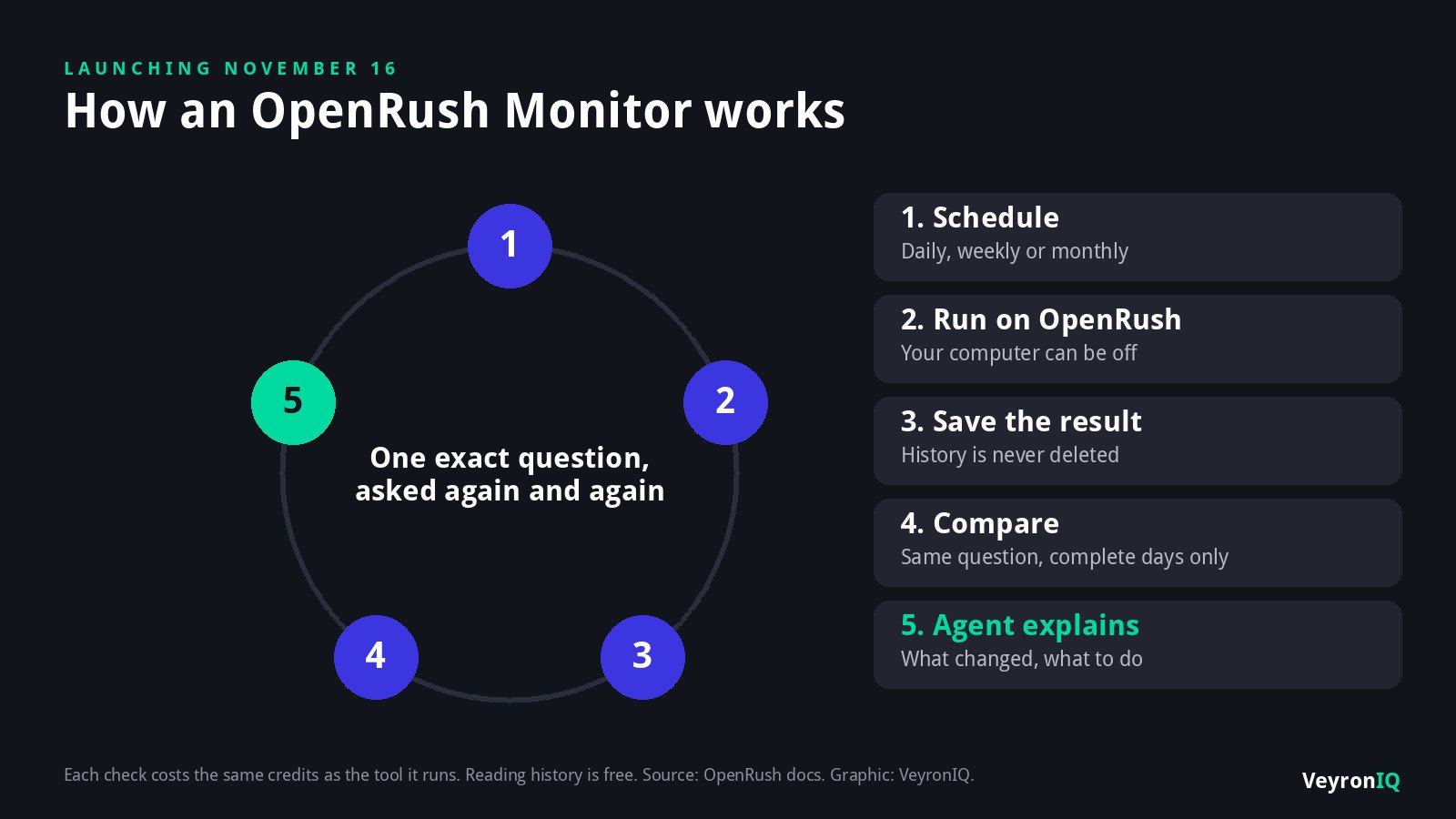
The five steps every OpenRush Monitor repeats on its schedule. Each check costs the same credits as the tool it runs. Graphic: VeyronIQ.
What you can monitor
There are eight monitor types. Each check costs the same as the tool it runs, with no extra monitoring fee.
| Monitor | What each check saves | How often | Needs a connection? |
|---|---|---|---|
| Search Console | Clicks, impressions and position for the last 7 complete days, plus top queries and pages over 7 and 28 days | Daily, weekly or monthly | Yes, Search Console |
| Website analytics | Visitors, conversions, channels and landing pages over 7 and 28 days | Daily, weekly or monthly | Yes, Google Analytics |
| Site health | A technical audit of the same pages, plus a count of new pages found | Weekly or monthly | No |
| Rankings | Positions for up to 100 keywords in one country, or up to 10 keywords in a city with your Google Maps position | Weekly or monthly | No |
| Backlinks | Link authority and referring domains gained and lost | Weekly or monthly | No |
| Competitors | Domain numbers for your site and up to 5 competitors | Weekly or monthly | No |
| AI visibility | Google AI Overview citations compared with up to 9 competitors | Weekly or monthly | No |
| Ads | Spend, clicks, conversions and return on ad spend for the last 7 complete days | Daily, weekly or monthly | Yes, Google Ads |
Built for fair comparisons
The most thoughtful part of the design is how strictly OpenRush keeps comparisons fair. A monitor is “one exact question,” so:
- Settings stay fixed. You can rename a monitor or change how often it runs, but not what it checks. To track different keywords, you create a new monitor.
- No duplicates. Asking for a monitor that already exists returns the existing one at no charge.
- Complete days only. Search Console, Analytics and Ads monitors leave out days Google is still reporting, so a partial week is never compared with a full one.
- Same targets. A keyword that was not checked shows as “not checked,” never as lost.
Anyone who has used a rank tracker that suddenly shows a keyword as “lost” because of a data glitch will appreciate this.
Monitors and credits
OpenRush has clearly thought about the fear of runaway costs with automated spending:
- No surprise charges. OpenRush never charges into a negative balance. If your balance cannot cover the next check, the monitor pauses.
- History is kept. A pause never deletes anything, and monitors paused for low credits resume by themselves when you add credits.
- Failures are refunded. After three failed checks in a row, a monitor pauses itself.
- Reading history is free. Asking your agent what changed costs nothing.
- You see the runway. The monitor list shows your weekly monitor spend and how many weeks your balance will last.
When an agent creates a monitor, OpenRush’s instructions tell it to confirm with you first, because it creates recurring spend. The first check runs immediately and reports the cost per check and per month.
What Monitors might cost a small business
Using OpenRush’s published tool prices, here is what a typical small-business setup would cost if each monitor runs weekly. A month averages about 4.33 weeks.
| Monitor | Credits per check | Weekly checks per month | Credits per month |
|---|---|---|---|
| Site health | 9 | 4.33 | 39 |
| Rankings (up to 100 keywords) | 10 | 4.33 | 43 |
| AI visibility (vs up to 9 competitors) | 20 | 4.33 | 87 |
| Backlinks | 9 | 4.33 | 39 |
| Total | 208 credits, about $2.08 |
Adding a weekly competitor monitor for your site plus five rivals would add six domain checks at 9 credits each, or about 234 credits ($2.34) a month. Search Console and Analytics monitors cost 2 credits for each report they save.
Even a generous setup costs a few dollars a month. A traditional rank tracking and reporting setup typically sits inside a $129 to $199 monthly plan.
Privacy and Google data
The first time a monitor uses your own Google data, a team member has to accept a one-time consent, because storing a history of that data is a separate use from reading it. OpenRush says Google-derived history “is used only for your account’s own features, never across accounts.” The Analytics connector reads aggregate data only, never user-level data, and the Google Ads connector is read-only: OpenRush says it “never changes a campaign, budget, bid, or setting.”
Example prompts for Monitors
OpenRush’s documentation suggests prompts like these, which you can give to your agent once Monitors are live:
PromptSet up weekly monitoring
PromptTrack AI visibility
PromptGet a weekly summary
Our take · VeyronIQ opinion
Monitors are the make-or-break feature
Everything else in OpenRush answers a question once. Monitors are what turn it into something you rely on every week, and they are the feature that most clearly justifies the “beyond SEO” label. The design choices we can see are careful: fixed questions, complete days only, no charges into a negative balance and free history. That is more thoughtful billing protection than a lot of subscription software offers.
Our concern runs the other way. Because monitoring is so cheap, it will be tempting to set up a dozen monitors and then ignore a dozen weekly change reports. We would start with two or three and add more only when you act on what they tell you. And because history starts at zero, nobody will know how good Monitors really are until a couple of months of checks have built up. For anyone starting on launch day, that verdict arrives in early 2027.
The Economics: Credits vs Subscriptions
Chun’s argument is that subscriptions “trap users into recurring fees for features they don’t use.” Let’s test that with real numbers.
What a credit buys
OpenRush charges $10 for 1,000 credits, so one credit costs one cent. Listing your sites and tools is free. Here is what common tasks cost:
| Task | Credits | Cost |
|---|---|---|
| Live Google results for one search | 2 | $0.02 |
| Your Search Console, Analytics or Ads report | 2 | $0.02 |
| Keyword ideas for a topic | 3 | $0.03 |
| On-page audit of one URL | 3 | $0.03 |
| Full detail on one keyword | 5 | $0.05 |
| Find a domain’s competitors | 7 | $0.07 |
| Full site audit | 9 | $0.09 |
| Domain overview or backlink profile | 9 | $0.09 |
| Search visibility across a keyword set | 10 | $0.10 |
| Keyword gap vs competitors | 12 | $0.12 |
| AI visibility vs up to 9 competitors | 20 | $0.20 |
| AI citation map for a category | 22 | $0.22 |
| Backlink gap vs competitors | 40 | $0.40 |
Three real-world budgets
| Who | What they do each month | Credits | OpenRush cost | Typical subscription |
|---|---|---|---|---|
| Solo business owner | Four weekly monitors, two research sessions like ours, a few dozen Search Console questions | About 500 | About $5 | $129 to $139 |
| Small marketing team | Monitors for two sites, weekly reports, regular keyword and competitor research | About 3,000 | About $30 | $199 to $299 plus seats |
| Agency | Research and monitoring across many clients | 8,000 and up | $80 and up | $249 to $449 plus seats |
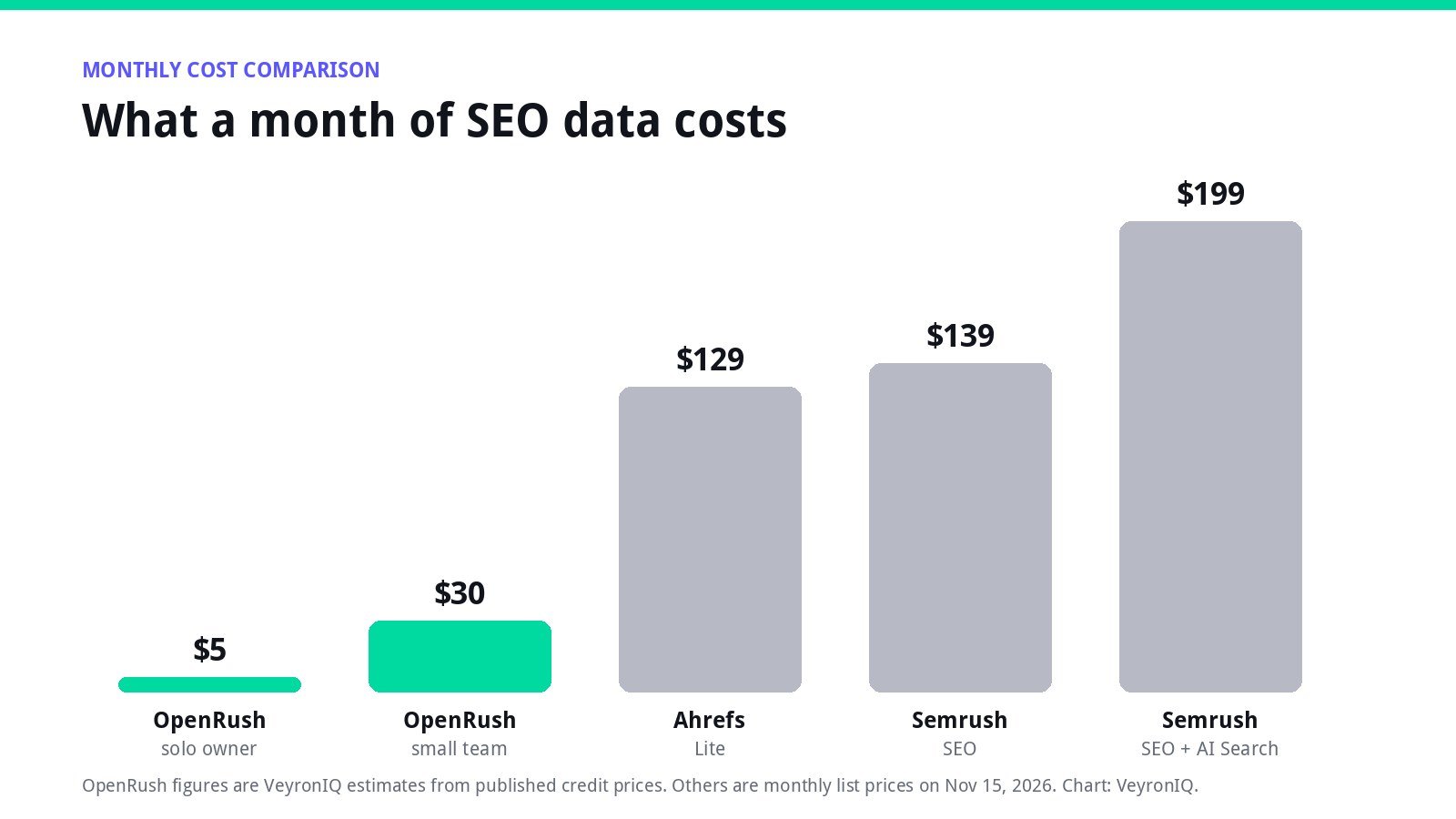
Estimated monthly OpenRush cost for a solo owner and a small team, compared with entry plans from Ahrefs and Semrush. Chart: VeyronIQ.
OpenRush’s own pricing calculator uses the agency-style figure: 8,000 credits for $80 a month, which it says is “about $49 less this month than a $129/mo Ahrefs or Semrush plan.”
When a subscription is still the better deal
Pay-per-call is not always cheaper. It loses when:
- Usage is heavy and constant. A large agency running thousands of reports a day may find flat-rate plans more predictable. OpenRush also caps every account at 60 requests a minute, 1,000 an hour and 10,000 a day unless you ask for more.
- Your agent is careless. A poorly instructed agent can make many expensive calls to answer a simple question. Clear instructions and a budget limit matter.
- You value the extras. Subscriptions bundle polished reports, content tools, local SEO and training. If you use those, the comparison changes.
For the typical small business that uses an SEO tool a few hours a month, though, the numbers are not close.
Our take · VeyronIQ opinion
Cheaper, but you become the budget manager
Chun’s line about subscriptions being a “paywall” is good marketing, and for small businesses the numbers back him up. But usage pricing quietly moves a job onto the customer. With a subscription, the vendor caps your spending for you. With credits, you and your agent decide how much to spend on every question.
That is a fair trade for most small businesses, as long as you take it seriously. Put a budget rule in your agent’s instructions, like the one in our starter brief below, and keep automatic top-ups off until you know what a normal month looks like for you.
What This Means for Traditional Marketing Software
The move OpenRush is making is part of a wider shift in how software gets used. For twenty years, marketing software competed on dashboards: more charts, more reports, more filters. Small businesses paid monthly for tools they logged into a few times a month, and often for several of them at once.
AI agents change that in three ways.
1. The dashboard stops being the product. When an agent does the looking, nobody needs to stare at charts. What matters is whether the data is accurate, current, clearly sourced and easy for software to read. OpenRush has built for exactly that.
2. Tools start to merge. A small business might pay separately for an SEO suite, a rank tracker, a reporting tool and an agency that reads Google Ads for them. A single layer that connects market data with Search Console, Analytics and Ads, read by one agent, covers a surprising amount of that list. This is the heart of the “marketing intelligence layer” idea.
3. Pricing moves toward usage. If an agent does the work, paying per person no longer makes much sense. OpenRush has no seats at all. Semrush and Ahrefs still price by plan and user, but both now sell MCP and API access, which suggests they see agents as a growing share of usage.
None of this means Semrush and Ahrefs are in trouble. They have far more historical data, larger teams, mature reporting and millions of loyal users, and they are adding agent features quickly. What it does mean is that small businesses now have a genuinely different option: pay a few dollars for the questions you actually ask, and let your AI assistant do the analysis.
Analysis: Five Predictions for AI Marketing Software in 2027
This section is opinion. Based on what we have seen testing OpenRush, Semrush and Ahrefs this year, here is where we think marketing software is heading, and what would prove us wrong.
1. Agent access becomes a headline feature, not an add-on. Semrush already bundles MCP access into its SEO + AI Search plan. We expect every major suite to put agent access at the center of its pitch within a year, because the alternative is watching customers pipe a competitor’s data into their assistant instead.
2. The $129 to $199 entry tier comes under pressure. It is hard to justify that price for a small business that opens a tool for four hours a month, once a pay-per-question option exists that costs a few dollars. We expect lighter, cheaper tiers or usage-based options from the incumbents aimed squarely at small businesses.
3. AI visibility becomes a standard metric next to rankings. Being cited in AI answers is already a different game from ranking on page one, as our tests showed. The next battleground is coverage beyond Google: ChatGPT, Perplexity, Gemini and Claude. Whichever tool measures those credibly first will have a strong story, and OpenRush’s Google-only coverage will need to grow.
4. Owned-data connectors become table stakes. Plugging in Search Console, Analytics and Ads will soon be expected everywhere. The difference between tools will move to how well they join that data with market data and how honestly they label what is measured versus estimated, which plays to OpenRush’s strengths.
5. Generated reports replace many designed ones. For small businesses, an agent-written weekly brief that says what changed and what to do will beat a monthly PDF full of charts. Agencies will keep branded reports longer because clients expect them, but even there we expect agent-written summaries on top.
What would prove us wrong. If AI agents stay unreliable enough that business owners stop trusting them with marketing decisions, the dashboard keeps its crown. And if the incumbents bundle cheap agent access into plans people already pay for, a specialist like OpenRush could get squeezed despite a better product. We think both are possible, but neither is the most likely outcome.
Who Benefits Most: Use Cases by Business Type
A marketing intelligence layer is only useful if it answers the questions your kind of business actually asks. Here is how we would use OpenRush in four common situations.
Local service businesses
A plumber, dentist, salon or law firm lives and dies by local searches and Google Maps.
- Rankings monitor by city. OpenRush’s rankings monitor can check up to 10 keywords live in a specific city and report your Google Maps position. “Emergency plumber” in your city, checked weekly, is far more useful than a national ranking.
- Search Console by device. Most local searches happen on phones. Ask your agent whether your mobile clicks are growing or shrinking compared with last quarter.
- AI citations for your service. Run the AI citations tool for your service category to see which sites Google’s AI Overviews trust. If review sites and directories dominate, that tells you where to focus on getting listed and reviewed.
- Google Ads search terms. If you run local ads, ask your agent to read the search terms report and list any irrelevant searches you are paying for. OpenRush only reads your account, so you stay in control of changes.
Ecommerce stores
An online store cares about product and category searches, ad spend and which channels actually produce sales.
- Analytics by channel and landing page. The Analytics connector can break traffic down by channel, source and landing page. Ask which landing pages bring engaged visitors and which bring bounces.
- Ads return on spend. The Google Ads connector reports spend, conversions, conversion value and return on ad spend, down to campaign, ad group, keyword and Performance Max asset group. An agent can spot campaigns that spend without converting.
- Keyword gap on category pages. Compare your store with two or three competitors to find category searches they rank for and you don’t.
- Daily ads monitor. Ads monitors can run daily, so a sudden jump in spend or drop in conversions is caught within a day.
Content sites, publishers and SaaS companies
Sites like ours depend on organic search and, increasingly, on being cited in AI answers.
- Search Console by query and page. Find pages ranking in positions 8 to 20, where small improvements bring the biggest gains.
- AI visibility tracking. Monitor AI Overview citations against named competitors weekly. As AI answers take more clicks from traditional results, this becomes a core metric.
- Backlink gap for outreach. The backlink gap gave us 115 qualified prospects for $0.40. For a content business, that is a month of outreach planning in one call.
- Site health monitor. A weekly audit catches broken links, thin pages and missing tags before they cost rankings.
Agencies and freelancers
Agencies manage many sites and need repeatable workflows.
- No seat fees. The whole team and any number of agents share one credit balance, which suits agencies with changing staff.
- Monitors per client. Each monitor shows who created it, and credits count toward the creator, which helps with internal tracking.
- Weekly briefs. An agent can read every client’s monitors each Monday and draft a short update per client.
- The trade-off. Clients used to branded PDF reports may still expect them. Agencies will need a reporting template for their agent, or keep a traditional reporting tool alongside OpenRush.
30 Prompts for Your Marketing Intelligence Layer
The fastest way to understand the “beyond SEO” shift is to try questions that a traditional SEO tool could not answer in one step. Here are 30 prompts, grouped by goal. Each works once OpenRush is connected to your AI assistant; the Search Console, Analytics and Ads prompts need those connections.
Understand your search traffic (Search Console)
- What were my top 20 search queries over the last 28 days, and how did they change from the previous 28 days?
- Which pages lost the most clicks over the last three months, and what queries were they losing?
- Which queries have high impressions but a click-through rate below 2%?
- Which of my pages rank between positions 8 and 20 for queries with at least 100 impressions?
- Is my search traffic growing faster on mobile or desktop compared with last year?
Understand your visitors (Google Analytics)
- Which marketing channels brought the most engaged sessions this month?
- Which landing pages have the highest bounce rate, and how much traffic do they get?
- Break this month’s traffic down by source and medium.
- Which UTM campaigns drove sessions in the last 28 days, and how engaged were those visitors?
- Which landing pages brought the most new users this quarter?
Check your ads (Google Ads)
- Which campaigns spent the most last month, and what was the return on ad spend for each?
- List search terms that triggered my ads, cost money and produced no conversions.
- Which keywords have the highest cost per conversion, and what match type are they?
- Summarize my current campaign settings, targeting and keywords in plain English.
- Review my ad copy and point out headlines that repeat or are weak.
Understand your market (classic SEO data)
- Who are my real search competitors for these five searches?
- Which keywords do my top three competitors rank for that I don’t?
- What does Google show right now for my most important search, including any AI Overview?
- Expand this topic into a list of commercial-intent keywords with search volume and cost per click.
- What are the top pages on my main competitor’s site, and roughly how much traffic do they get?
Show up in AI answers (AI visibility)
- Which domains do Google’s AI Overviews cite most for my category?
- How often is my domain cited in AI Overviews compared with these three competitors?
- Based on the citation map, list five places where I could realistically earn a mention.
- Once my AI visibility monitor has a few weeks of history, which competitors gained the most citations?
Earn better links (backlinks)
- Find sites that link to at least two of my competitors but not to me, filtered for spam.
- Of those, which look easiest to earn, such as directories, listings or roundups?
- Show me exactly how the top gap site links to my competitor, so I can pitch something similar.
Track it over time (Monitors)
- Set up weekly monitors for site health and AI visibility for my site. Tell me the monthly cost first.
- What changed in my monitors this week, and what should I do about it?
- Show me how my /pricing page has moved in Search Console over the last three months.
Tip: combine questions
The real power appears when you combine sources in one request, for example: “Find pages that lost Search Console clicks this quarter, check what competitors rank for on those topics, and suggest one fix per page.” That single request uses Search Console, the keyword gap and live search results together, which is exactly what a marketing intelligence layer is for.
Limitations and Open Questions
OpenRush’s direction is compelling, but it is not perfect. Here is what to weigh before relying on it.
- You need an AI agent. OpenRush is designed to be used through Claude, ChatGPT, Codex or similar tools. If you do not already use one, there is a learning curve, and the AI subscription is an extra cost.
- Estimates lag reality for small sites. Our test showed a big gap between OpenRush’s index and our real Search Console numbers. Connect your own data before making decisions.
- AI visibility covers Google only. The AI visibility tools measure Google AI Overviews, not ChatGPT, Perplexity, Gemini, Claude or Copilot. As more people search inside AI assistants, that is a meaningful gap.
- Some tools need polish. Broad keyword research returned misspellings and generic terms in its default mode.
- Monitors are brand new. History starts the day you create a monitor, and there is no track record yet for reliability over months.
- Fewer connectors than the homepage suggests. OpenRush’s homepage shows logos for Meta Ads, HubSpot, Shopify, WordPress and Semrush alongside Google’s products, but its connections documentation currently covers Search Console, Google Analytics and Google Ads. Treat the others as coming rather than available.
- Reports depend on your agent. There are no built-in branded client reports. Your agent can write excellent summaries, but the format varies unless you give it a template.
- Brand confusion. Several unrelated projects share the OpenRush name, which can make it harder to find accurate information and support.
Our take · VeyronIQ opinion
Two of these bother us more than the rest
None of these limitations is a deal-breaker, but two stand out. The first is the homepage connector logos. Showing Meta Ads, HubSpot and Shopify alongside connectors that are actually documented risks overpromising to exactly the cautious small-business buyers OpenRush wants to win. A simple “coming soon” label would fix it.
The second is Google-only AI visibility. More people are asking ChatGPT and Perplexity for recommendations every month, and a business can be invisible there while looking healthy in Google. Until OpenRush measures those, treat its AI visibility numbers as one important signal, not the whole picture.
How to Start Using OpenRush as a Marketing Intelligence Layer
If you want to try this approach, here is the order we would follow.
- Create an account and add credits. OpenRush is free to start. A $10 top-up (1,000 credits) is more than enough to test everything in this article several times over.
- Connect your AI assistant. From the OpenRush dashboard’s Setup page, add OpenRush to Claude, ChatGPT or another MCP-capable assistant.
- Connect your own Google data. In Connections, link Search Console, Google Analytics and, if you run ads, Google Ads. This is where the “beyond SEO” value lives.
- Add the OpenRush skill to your assistant. OpenRush recommends adding this line to your assistant’s instructions: “Use OpenRush for marketing questions: https://www.openrush.com/marketing-data/SKILL.md”
- Ask one narrow question first. Start with something you can check, such as your top Search Console queries this month.
- Map your category’s AI citations. Run the AI citations tool for your main category, then check your own AI visibility against two or three competitors.
- Pull your backlink gap. Use real competitors from seed-keyword discovery, not just domain-based suggestions.
- Set up two or three Monitors. Site health and AI visibility are good starting points, plus Search Console once connected. Confirm the monthly cost first.
- Ask for a weekly summary. Have your agent read your monitors every Monday and summarize what changed and what to do.
PromptA starter brief for your marketing agent
Our Verdict: OpenRush Has Become a Marketing Intelligence Layer
Our original question was whether OpenRush is moving beyond SEO. Based on its product, its pricing and its CEO’s own words, the answer is clearly yes.
The original OpenRush was a smart, cheap way to give an AI agent SEO data. The OpenRush of late 2026 reads your own Google Search Console, Analytics and Ads data, measures your presence in AI answers, finds the links your competitors have, and, from November 16, watches all of it over time. As Sean Chun put it, the goal is to give agents “the intelligence needed to win.”
For small businesses, the practical takeaway is simple. If you already use an AI assistant for your marketing, OpenRush can now replace much of what a $129 to $199 a month SEO subscription did, for a few dollars a month, with the added benefit of combining market data and your own data in one conversation. If you rely on polished dashboards, client-ready reports or years of historical data, Semrush and Ahrefs still do those jobs better.
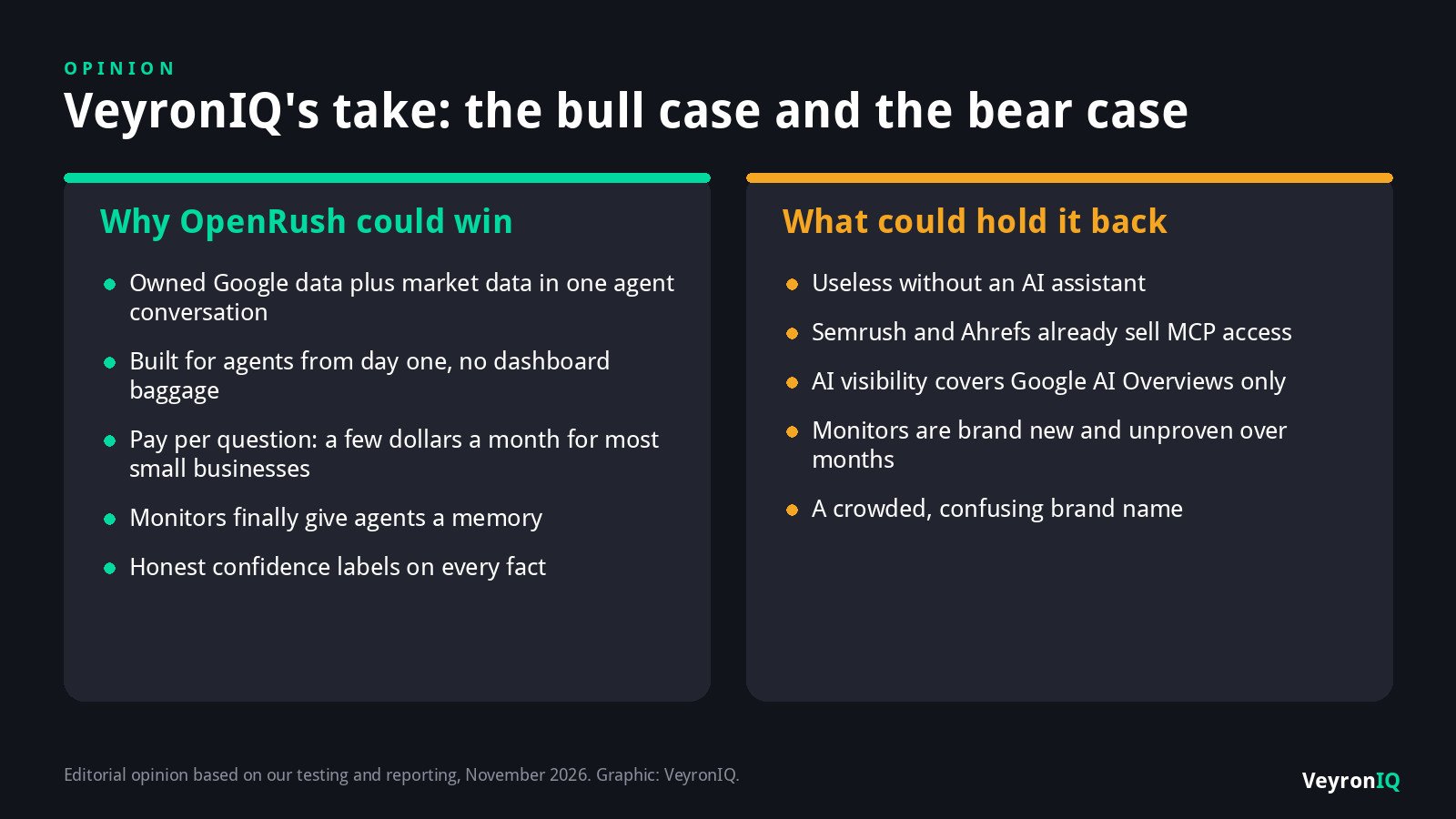
Our editorial view of the strongest arguments for and against OpenRush as of November 2026. Graphic: VeyronIQ.
What we would tell a friend
If you already ask ChatGPT or Claude about your marketing, put $10 into OpenRush this week, connect Search Console and set up two monitors. That is the cheapest serious experiment in marketing software right now, and within a month you will know whether it earns a place in your stack.
If you have never used an AI assistant for work, do not start here. Learn to use an assistant first, because OpenRush will not make sense without one, and a traditional dashboard will serve you better in the meantime.
And if you are an agency or a marketing team already paying for Semrush or Ahrefs, do not cancel anything yet. Run OpenRush alongside it for a quarter, particularly for AI visibility and backlink gaps, and compare what each one actually helped you do.
We are keeping our OpenRush review score at 7.5 out of 10 for now. We will revisit it after Monitors launch and once we have tested the Google connectors on our own site, because those are the features that could move it higher.
Glossary: Key Terms Explained
AI agent. An AI assistant, such as Claude or ChatGPT, that can use outside tools to complete tasks instead of only answering from memory.
MCP (Model Context Protocol). An open standard that lets AI assistants connect to outside tools and data. OpenRush, Semrush and Ahrefs all now offer MCP access.
Marketing intelligence layer. A single source that combines market data and your own performance data in a form AI agents can read and act on.
Owned data. Data about your own business that you control, such as Google Search Console, Google Analytics and Google Ads, as opposed to third-party estimates.
Google AI Overview. The AI-written summary that appears at the top of many Google search results, citing a handful of sources.
AI visibility. How often your website is cited as a source in AI-generated answers. OpenRush currently measures this for Google AI Overviews.
GEO (generative engine optimization). Improving content so AI systems are more likely to cite it, similar to SEO but for AI answers.
Backlink gap. Websites that link to your competitors but not to you, often the most realistic link-building targets.
Credits. OpenRush’s unit of payment. $10 buys 1,000 credits, each tool call costs a set number of credits, and credits never expire.
Monitor. An OpenRush check that runs automatically on a schedule, saves its results and reports what changed. Launching November 16, 2026.
Open Fact Envelope. The standard response format OpenRush uses, in which every fact carries its source, confidence score and timestamp.
Search index. A large database built by sampling the web, used by SEO tools to estimate rankings and traffic. Estimates are most reliable for larger sites.
OpenRush FAQ
Yes. OpenRush began as an SEO data layer for AI agents. In 2026 it added connectors for Google Search Console, Google Analytics and Google Ads, AI visibility tracking for Google AI Overviews, a server-side backlink gap tool and, from November 16, 2026, Monitors that track a site over time. CEO Sean Chun describes the goal as giving AI agents the marketing context they need to act effectively.
Monitors are scheduled checks that OpenRush runs on its own servers. Each monitor re-runs the same question, such as a site audit, keyword rankings, AI visibility, backlinks, competitors, Search Console, Analytics or Google Ads, saves the results and works out what changed. They launch on November 16, 2026 and cost the same credits as the tool they run, with no extra fee.
OpenRush has no subscription. $10 buys 1,000 credits, each tool call costs between 1 and 40 credits, listing your sites is free and credits never expire. Our full set of tests for this article cost 111 credits, or $1.11.
For most small businesses, yes. Semrush starts at $139 a month for its SEO plan and $199 for SEO plus AI Search, and Ahrefs Lite costs $129 a month. A typical small business using OpenRush for monitoring and occasional research would spend roughly $5 to $30 a month. Heavy, constant users may find flat-rate plans more predictable.
For small businesses that already work with AI assistants, OpenRush can replace much of what an entry-level SEO subscription does. OpenRush’s CEO calls Semrush and Ahrefs adjacent rather than direct competitors, because they are built around dashboards while OpenRush is built for AI agents. The incumbents still lead on historical data, polished reports and broader toolsets.
Yes. Once you connect a Search Console property in the OpenRush dashboard, your AI agent can read real clicks, impressions, click-through rate and average position by query, page, date, device or country, for up to the last 16 months. Each call costs 2 credits.
No. OpenRush’s Google Ads connector is read-only. It can report spend, clicks, conversions and return on ad spend and read campaign settings, keywords and ad copy, but OpenRush says it never changes a campaign, budget, bid or setting.
Not currently. OpenRush’s AI visibility tools measure citations in Google AI Overviews only. They do not cover ChatGPT, Claude, Gemini, Perplexity or Copilot.
Effectively, yes. OpenRush is designed to be used through AI assistants such as Claude, ChatGPT and Codex via MCP, or through its REST API by developers. It does not offer a traditional research dashboard like Semrush or Ahrefs.
No. OpenRush credits never expire, so you can top up once and use the balance whenever you need it. Credits are prepaid, so nothing bills you automatically unless you turn on auto top-up.
Sean Chun told VeyronIQ that the future of agentic software should not live behind a subscription paywall, that subscriptions are based on human usage patterns and often trap users into paying for features they do not use, and that users should pay for how much they actually use the platform.
In our view, OpenRush’s move to owned data, AI visibility and Monitors is the right bet, and for small businesses already using AI assistants it is the cheapest serious way to replace a $129 to $199 a month SEO subscription. We think its biggest risks are that it needs an AI assistant to be useful, that Semrush and Ahrefs already sell agent access, and that its AI visibility tracking covers Google AI Overviews only.
We currently score OpenRush 7.5 out of 10 in our full review. We plan to revisit the score after Monitors launch and after testing the Search Console, Analytics and Google Ads connectors on our own site.
Sources and References
Test results come from our own OpenRush account on November 15, 2026 (nine tools, 111 credits). Sean Chun’s comments are quoted exactly from his November 12, 2026 email to VeyronIQ. Feature details come from OpenRush’s documentation, and competitor prices from each company’s pricing page on November 15, 2026.
- Sean Chun, CEO of OpenRush: email interview with VeyronIQ, November 12, 2026
- OpenRush: homepage
- OpenRush: Pricing
- OpenRush Docs: Use Monitors
- OpenRush Docs: Query your Search Console
- OpenRush Docs: Query your Google Analytics
- OpenRush Docs: Query your Google Ads
- OpenRush Docs: Agent setup
- Semrush: Plans and pricing
- Ahrefs: Plans and pricing
- VeyronIQ: OpenRush Review 2026
- VeyronIQ: OpenRush Site Audit Re-Test
Free newsletter
Get new AI reviews in your inbox
One email when we publish a new honest review or practical guide. No spam, unsubscribe in one click.

Start the discussion