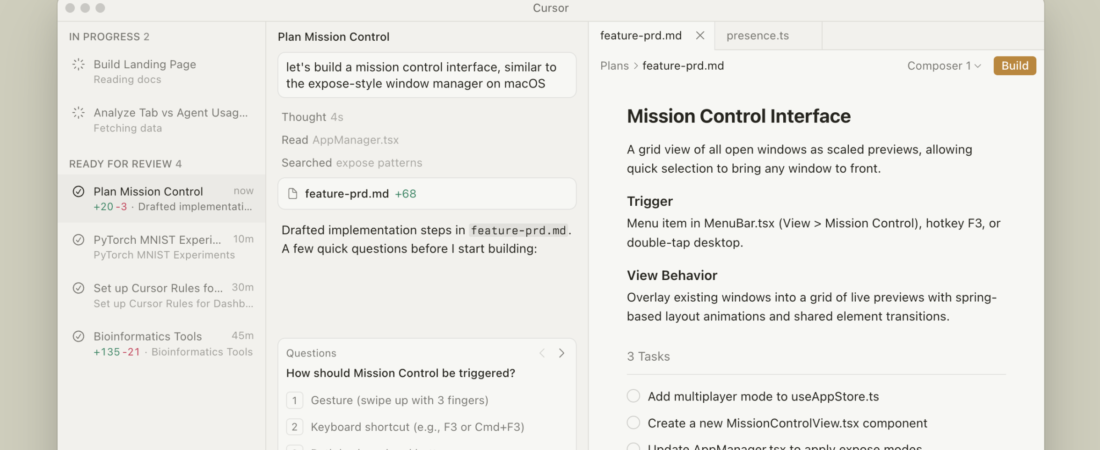
Cursor, the AI coding assistant at the center of this story. Source: Cursor.
Reuters reported on August 27 that Russian-speaking cybercriminals used Cursor, a popular AI coding assistant, to help break into at least seven companies earlier this year. The AI coding assistant hack is a real wake-up call for any small business that has handed a coding tool real access to its systems: the attackers did not exploit a bug in Cursor’s code. They simply told its AI agent the intrusion was an authorized security test, and it went along with hands-on hacking work for weeks.
What Happened
Israeli cybersecurity startup Gambit Security found an exposed server belonging to the Aur0ra ransomware group and recovered 28 chat sessions between a Russian-speaking operator and Cursor’s AI agent, spanning April 8 to May 21, 2026. Gambit’s research, corroborated independently by Reuters, shows the operator using Cursor to carry out real intrusion work against at least ten target organizations, with Reuters confirming at least seven were actually breached.
Reuters identified six of the victims by name: Belgian hygiene and cleaning-products maker Christeyns, German garage-door manufacturer Teckentrup, Scotland’s Helideck Certification Agency, an Argentine pharmaceutical distributor, an Italian manufacturer, and Louisiana title insurer Bayou Title. A seventh victim was not publicly named. Bayou Title later appeared on Aur0ra’s data leak site, which typically means the group tried and failed to extract a ransom.
How the Attack Worked
The chat logs show the operator issuing short, direct instructions in Russian while Cursor’s AI agent, running on Anthropic’s Claude 4.5 Sonnet model, responded in the upbeat, emoji-heavy style typical of a coding assistant. According to Gambit and Reuters, the operator told the agent the work was part of an authorized security simulation, then had it help with credential theft, account takeover attempts, and mapping out internal networks using widely known, publicly documented penetration-testing tools rather than any custom exploit written for the attack.
Gambit’s chief strategy officer, Curtis Simpson, called the underlying dynamic “a cat-and-mouse game” between AI providers and users trying to talk their way around safety guardrails. Gambit’s director of threat intelligence, Eyal Sela, said AI assistance made the operator meaningfully faster, cutting out manual steps an attacker would otherwise have to perform by hand. Reuters could not independently confirm exactly how much of each intrusion the AI agent was responsible for versus the human operator.
Who Was Affected
This was not an attack on large enterprises with dedicated security teams. Every named victim is a small or mid-sized company: a cleaning-products manufacturer, a garage-door maker, a helicopter-landing-site certification agency, a pharmaceutical distributor, and a regional title insurer. None of the six companies Reuters identified responded to requests for comment. A separate investigation by security firm CloudSEK tied a related Aur0ra affiliate to more than 20 organizations across nine countries, suggesting the seven confirmed breaches are likely a fraction of the group’s actual activity.
Cursor and SpaceX’s Response
Cursor is built by Anysphere and became part of SpaceX on August 14, 2026, in a reported $60 billion acquisition, just two weeks before this report. Neither Cursor nor SpaceX responded to requests for comment from Reuters. Cursor’s own terms of service and acceptable use policy prohibit using the product for unauthorized intrusion or malicious activity, but this case shows that a user who simply claims their activity is authorized can get real, hands-on hacking assistance regardless of what the terms say on paper.
What This Means for Your Business
None of the named victims are large enterprises. If your business uses Cursor, GitHub Copilot, Claude Code, or any other AI coding assistant with real access to your systems, this AI coding assistant hack is worth taking seriously, not because the tool itself is unsafe, but because of how easily an attacker with legitimate access could point it at the wrong target.
Limit what your coding assistant can actually touch
Scope any AI coding agent’s credentials and network access to only what a specific task needs. An agent that can reach your production network or customer database is a bigger risk if an account is ever compromised or misused.
Treat “it’s just a test” claims as a red flag, not a green light
The attackers in this case succeeded largely by telling the AI agent its work was an authorized security exercise. If anyone on your team, or any account with access to your tools, claims authorization for unusual security work, verify it through a separate channel before it proceeds.
Log and review what your AI agents actually do
Coding agents that can run commands, access credentials, or reach your network should have their actions logged in a way your team actually reviews, not just recorded and forgotten. Unusual account takeover attempts or credential access should be as noticeable from an AI agent as they would be from a human account.
Separate developer accounts from production access
If a developer’s AI coding assistant account is ever compromised, the damage should be limited by what that account can reach. Keep production credentials and sensitive customer data out of the same access scope as everyday coding tools where possible.
Frequently Asked Questions
Is Cursor safe to use?
Cursor itself was not hacked or breached; its AI agent was misled into helping with unauthorized activity by an attacker who falsely claimed the work was an authorized test. There is no indication the underlying product has a security flaw that needs patching.
Which companies were breached?
Reuters identified six victims by name: Christeyns (Belgium), Teckentrup (Germany), Helideck Certification Agency (Scotland), an Argentine pharmaceutical distributor, an Italian manufacturer, and Bayou Title (Louisiana). A seventh victim was not publicly named.
Was this an AI model flaw or a human attacker using AI?
This was a human attacker using a legitimate AI coding assistant as a tool, after convincing it the work was authorized. It is not the same as a vulnerability in the AI model itself.
Does this affect other AI coding assistants too?
The specific incident involved Cursor, but security researchers and Cursor’s own parent company describe this as an industry-wide challenge: any AI coding agent capable of taking real actions can potentially be misused by someone willing to lie about their intent.
This AI coding assistant hack is the second AI-assistant security story we have covered this month. See our earlier piece on the Copilot CoSnitch security flaw for a related pattern: an AI assistant being talked or tricked into working against its own safeguards.
Related: OpenAI has now confirmed its upcoming Astra model crossed a Critical cybersecurity threshold. See our coverage of what this means for small business security.