Nearly half of all Google searches now carry local intent, and this local SEO for small business guide covers exactly what moves a business into the map pack in 2026: a Google Business Profile Google actually trusts, reviews it can read for specificity, and a website that backs up what the profile claims.
On this page
- Executive Summary
- The Three Pillars: Relevance, Distance, Prominence
- Step 1: Build a Complete Google Business Profile
- Step 2: Fix NAP Consistency Everywhere
- Step 3: Build a Review Engine, Not a Review Pile
- Step 4: Optimize Your Website for Local Signals
- Step 5: Earn Local Citations and Local Links
- Step 6: Keep the Profile Active
- Common Mistakes
- Quick Reference Checklist
- Frequently Asked Questions
- Key Takeaways
- Sources and References
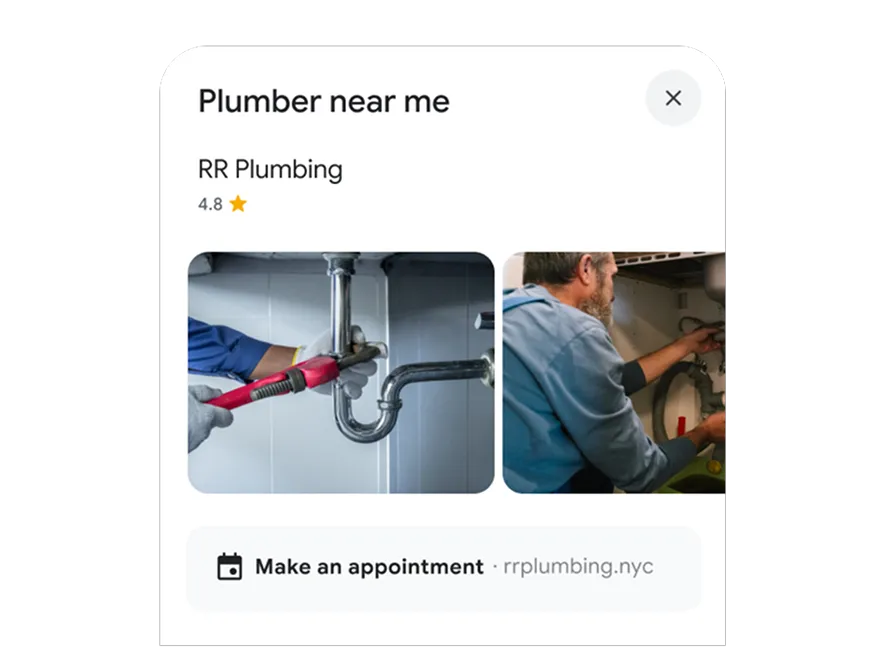
A local pack result for a “plumber near me” search, showing rating and a direct booking link. Source: Google.
Executive Summary
Google’s local search algorithm runs separately from standard organic search, and it ranks the map pack, the three business listings shown for a query like “plumber near me,” on three factors Google itself names: relevance, distance, and prominence. One 2026 signal-weighting analysis breaks the practical mix down further: Google Business Profile signals carry roughly 32 percent of the weight, on-page signals 19 percent, review signals 16 percent, link signals 15 percent, behavioral signals 8 percent, and citation signals 7 percent.
The March 2026 core update changed two things worth knowing before doing local SEO for a small business in 2026. First, profile completeness now correlates much more tightly with local pack visibility, businesses missing hours, services, or photos saw disproportionate ranking drops. Second, review recency and owner response rate overtook raw review count as a ranking signal, a business with fewer, fresher, answered reviews now often outranks one sitting on a large pile of old, unanswered ones.
Who should read this local SEO for small business guide: any business with a physical location or a defined service area trying to show up in Google’s local pack, Maps, and local organic results, not just standard web search.
The Three Pillars: Relevance, Distance, Prominence
Relevance
How well your business matches what someone is actually searching for. Google reads this from your Google Business Profile category, your website content, and your service descriptions, this is the factor you have the most direct control over.
Distance
How close your business location is to the searcher, or to the location implied in the search. You cannot directly control this, but an accurate service-area setting in your profile ensures Google evaluates the right radius for your actual business.
Prominence
How well-known and well-regarded your business is across the web, built from reviews, citations, backlinks, and general online visibility. This is the slowest factor to build and the one most local SEO work is ultimately aimed at.
Step 1: Build a Complete Google Business Profile
Goal: give Google every signal it needs to trust and fully display your listing, since profile completeness is now the single heaviest-weighted local ranking factor.
Fill in every section: accurate hours (including holiday hours), your correct primary category, a complete list of services or products, your service area if you don’t serve walk-in customers, and a business description under the 750-character limit that describes what you do rather than a list of promotions. Add high-quality, current photos regularly, profiles with quality photos generate roughly 40 percent more direction requests and 31 percent more website clicks according to 2026 industry data.
Step 2: Fix NAP Consistency Everywhere
Goal: make sure your business Name, Address, and Phone number match exactly everywhere they appear online.
A mismatched suite number, an old phone number still listed on a directory, or your business name written two different ways across your website and your Google Business Profile all weaken the prominence signal Google uses to judge your legitimacy. Search your business name and old address to find outdated listings on directories, and correct or remove them.
Step 3: Build a Review Engine, Not a Review Pile
Goal: build a steady flow of specific, answered reviews, since Google now weighs recency and response rate over raw count.
The 2026 benchmark from industry review data is two to five fresh reviews a week with a response time under 24 hours. Ask for reviews right after a completed job or purchase, when the experience is freshest. A review with real detail (“they handled our appointment scheduling quickly and showed up on time”) teaches Google’s AI systems something specific about your business; a bare five-star rating with no text does very little for that signal. Respond to every review, positive or negative, since owner response rate is now an explicit ranking input, not just a courtesy.
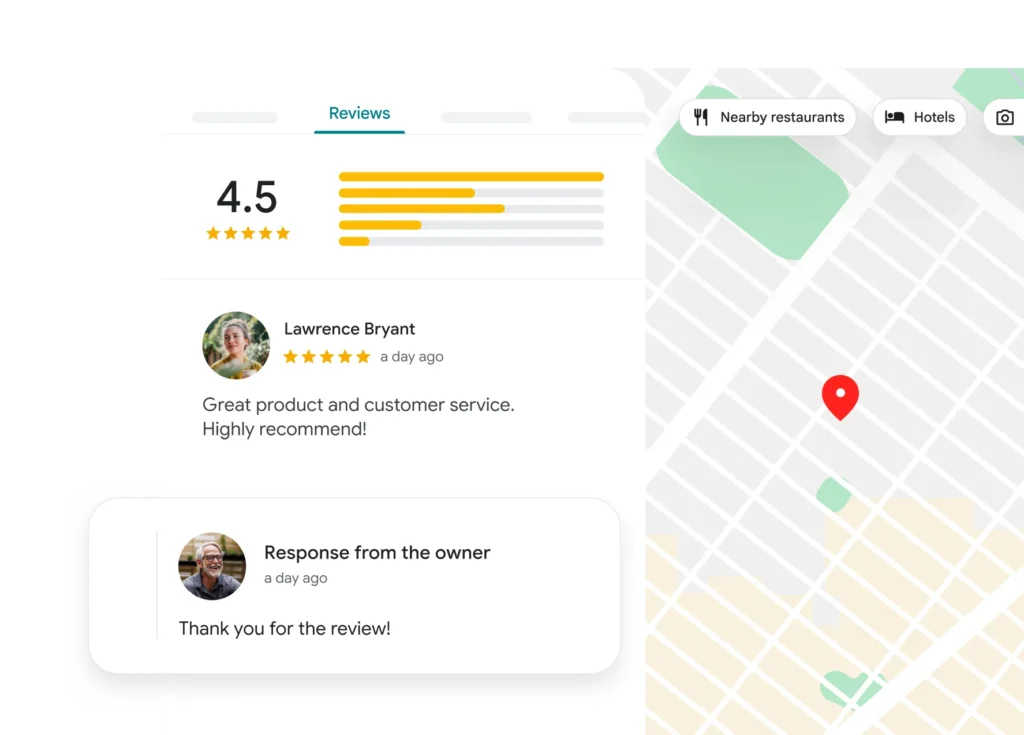
A business owner responding to a customer review on Google Maps. Source: Google.
Step 4: Optimize Your Website for Local Signals
Goal: give Google website-side evidence that backs up what your profile already claims.
Include your city and service directly in title tags and H1s where it reads naturally, for example “Plumbing Services in Austin, TX” rather than a generic “Our Services” heading. If you serve multiple distinct areas, a dedicated page per location or service area, with genuinely different content rather than a copy-pasted template, gives Google real content to match against local searches. Embed a Google Map with your correct location, and make sure your site loads quickly and works properly on mobile, since local searches skew heavily toward mobile devices.
Step 5: Earn Local Citations and Local Links
Goal: build the link and citation signals that make up roughly 22 percent of the local ranking mix combined.
Local SEO for small business also means citations: list your business accurately on real, recognized directories: your local chamber of commerce, industry-specific directories, and platforms relevant to your category. For backlinks specifically, local news sites, community organizations, and industry blogs send a much stronger local relevance signal than a generic national directory. If you haven’t already, our full guide on how to build backlinks for small business covers the tactics that work under Google’s current spam enforcement, the same rules apply whether the link is local or not.
Step 6: Keep the Profile Active
Goal: avoid the specific 2026 penalty for going quiet, profiles inactive for 30 or more days are reporting measurable drops in impressions.
Post to your Google Business Profile regularly, the 2026 benchmark is around two posts a week, and Google now allows scheduling in advance, so a month of posts can realistically be batched in one sitting. Keep photos current, update seasonal hours promptly, and treat the profile as a living page rather than a one-time setup task.
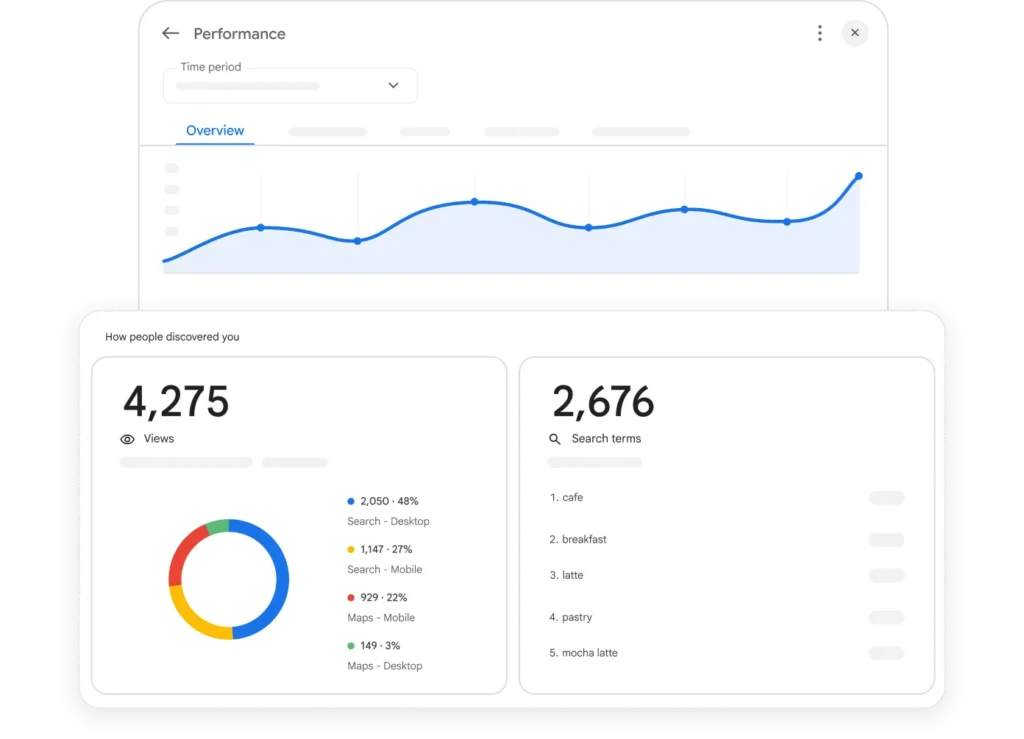
Google Business Profile insights showing performance, views, and search terms. Source: Google.
Common Mistakes
- Adding keywords into your Google Business Profile business name to game rankings. Google continues cracking down on this and it risks a profile suspension.
- Choosing the wrong primary category, which can suppress visibility even for an otherwise well-optimized, established business.
- Chasing raw review volume while ignoring response rate, since recency and response rate now outweigh count.
- Letting NAP details drift out of sync across your website, Google Business Profile, and old directory listings.
- Treating the Google Business Profile as a one-time setup instead of an ongoing weekly task; profiles inactive 30-plus days measurably lose impressions.
Quick Reference Checklist
- Complete every section of your Google Business Profile: hours, category, services, service area, description, photos.
- Audit and correct NAP consistency across your website, profile, and any directory listings.
- Build a weekly habit of asking for reviews and responding to every one within 24 hours.
- Add your city and service naturally into title tags and H1s on relevant pages.
- Create genuinely distinct location or service-area pages if you serve more than one area.
- List your business on your local chamber of commerce and real industry directories.
- Pursue backlinks from local news, community organizations, and industry blogs.
- Post to your Google Business Profile roughly twice a week, and keep photos current.
Frequently Asked Questions
How long does local SEO take to show results for a small business?
Basic Google Business Profile fixes can show up in weeks. Building genuine review velocity, citations, and local links to meaningfully move map pack rankings typically takes three to six months of consistent work.
Do I need a website for local SEO to work?
A Google Business Profile alone can drive visibility, but a website with local content, correct titles, and location pages significantly strengthens the relevance signal Google uses to rank you.
How often should I post to Google Business Profile?
The 2026 benchmark is around two posts per week. Profiles inactive for 30 or more days are reporting measurable drops in impressions.
Do backlinks matter for local SEO?
Yes, link signals make up a real share of the local ranking mix, and links from local news sites, chambers of commerce, and community organizations carry more local relevance than a generic national link.
Is local SEO different from regular SEO?
Yes. Google runs a separate local algorithm weighted toward relevance, distance, and prominence, evaluated primarily through your Google Business Profile, reviews, and citations, on top of standard on-page and technical SEO.
Key Takeaways
- Google ranks local results on relevance, distance, and prominence, with Google Business Profile completeness now the single heaviest-weighted factor after the March 2026 core update.
- Review recency and response rate now matter more than raw review count.
- NAP consistency across your website, profile, and directories remains a foundational trust signal.
- Local backlinks and citations, especially from local news and community organizations, carry real ranking weight.
- An inactive profile is now actively penalized; consistent weekly activity outperforms an occasional burst of effort.
Sources and References
Seahawk Media: Local SEO Ranking Factors, the Complete Guide for 2026
Digital Applied: Local SEO After the March 2026 Core Update
ClickRank: Local SEO Ranking Factors 2026, signal weighting breakdown
Scatterbranch Marketing: Google Business Profile 2026 Updates
Google: official Google Business Profile page
Pair this with our backlinks guide and organic traffic guide for the full picture, or see our Google Business Profile guide for a deeper walkthrough of profile setup.
Rounding out your marketing stack? See our Email Marketing for Small Business guide for 2026 deliverability rules and real send-time data.