Backlinks still matter in 2026, but the game has changed. Google’s SpamBrain system now enforces link-quality standards continuously rather than through occasional sweeps, and the October 2025 update specifically targeted AI-generated guest post farms built purely to carry paid links. This guide covers how to build backlinks for small business sites the way that actually survives 2026 enforcement: fewer links, earned honestly, from sites that are actually relevant to what you do.
On this page
- Executive Summary
- What Actually Counts as a Quality Backlink Now
- Step 1: Audit What You Already Have
- Step 2: Build One Genuinely Linkable Asset
- Step 3: Reclaim Unlinked Mentions
- Step 4: Use Directories That Are Actually Worth It
- Step 5: Guest Content Done Right
- Step 6: Digital PR and Journalist Outreach
- Step 7: Fix Broken Links Pointing at Competitors
- What to Avoid in 2026
- Common Mistakes
- Quick Reference Checklist
- Frequently Asked Questions
- Key Takeaways
- Sources and References

Backlink analysis tools like Semrush help audit and track a link profile. Source: Semrush.
Executive Summary
Backlinks are still one of the strongest ranking signals Google uses, but the criteria for a link that actually helps have narrowed. Google’s Search spam report has credited its SpamBrain system with cutting search spam by more than 99 percent compared to the pre-machine-learning baseline, and enforcement now runs continuously rather than through periodic, visible updates. The October 2025 spam update specifically targeted large-scale operations publishing thin, AI-generated guest posts solely to embed paid backlinks, and the June 2026 update reinforced the same pattern against private blog networks, undisclosed paid links, and comment spam.
What that means in practice for a small business: raw link count and third-party authority scores (DR, DA) matter far less than topical relevance and whether a link would exist if it did not help your rankings. This guide walks through exactly how to build backlinks for small business sites at a realistic, small-business-scale pace to earning links that survive that scrutiny, plus the specific patterns worth avoiding entirely.
What Actually Counts as a Quality Backlink Now
Google treats a backlink as an editorial recommendation. A link earns ranking value when the linking site genuinely found your content useful, not because you paid for placement or traded links in a reciprocal arrangement. Three factors now carry more weight than raw link count:
Topical relevance
A link from a site that covers the same subject as your business carries far more weight than a link from an unrelated, high-authority domain.
Editorial independence
The linking site should have no financial relationship to the placement. A guest post accepted purely because you paid a fee, on a site that accepts nearly any submission, is exactly the pattern SpamBrain is built to detect.
Natural pace and anchor text
A sudden spike in new links, or a heavy concentration of exact-match keyword anchor text, reads as manipulation rather than organic growth.
Step 1: Audit What You Already Have
Goal: know what you are starting from before spending any time on outreach.
Before building anything new, check your current backlink profile for two things: sites that already mention your business without a link, and any existing links that look manipulative (footer links, comment spam, or links from clearly unrelated foreign-language sites). A backlink audit tool such as OpenRush or a similar SEO platform will surface both in one pass. Cleaning up or disavowing toxic links first means new, legitimate links are not diluted by an existing spam pattern.
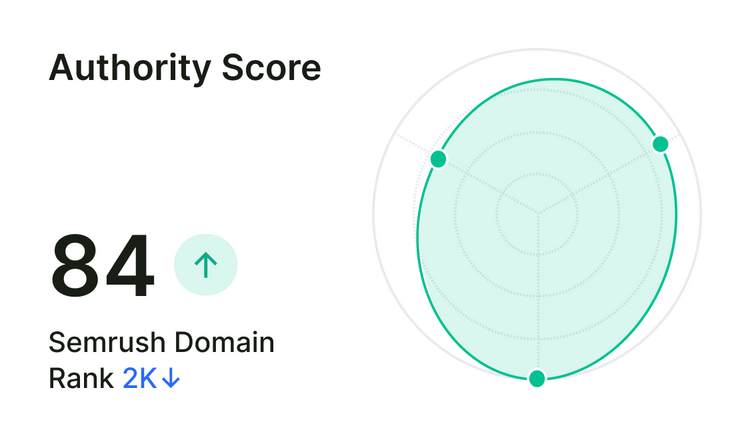
A backlink profile overview showing referring domains and authority metrics. Source: Semrush.
Step 2: Build One Genuinely Linkable Asset
Goal: create something other sites want to reference on their own, without being asked.
People link to a genuinely useful asset, not to a page that simply states a business is the best at something. A detailed original guide, a real benchmark or data page built from your own numbers, a free template, or a small functional tool all qualify. This only needs to happen once per asset; a single well-built resource can earn links for years with no ongoing outreach at all.
Step 3: Reclaim Unlinked Mentions
Goal: turn mentions that already exist into real links, which is usually the fastest win available.
Search your business name, without your own site as a source, to find articles, forum threads, or directory listings that mention you without linking to you. A short, polite email asking the site to add a link is one of the highest success-rate outreach types that exists, since the writer already chose to mention you once.
Step 4: Use Directories That Are Actually Worth It
Goal: claim listings that carry real citation value, and skip the low-quality bulk directories.
Local business associations, chamber of commerce listings, your industry’s recognized trade directories, and platforms like Google Business Profile all count as legitimate citations, not link spam, because they exist for a genuine purpose beyond passing link value. Bulk, generic web directories with no editorial standard are the opposite: low effort, low value, and part of the pattern SpamBrain is built to discount.
Step 5: Guest Content Done Right
Goal: use guest content for real relationship and audience access, not as a link-buying shortcut.
Guest posting itself is not against Google’s guidelines; the problem is scale without editorial standards. A site that accepts nearly any submission, publishes thin or unedited AI-generated articles, or exists mainly to carry commercial anchor text is a red flag for both your rankings and the relationship. Pitch a small number of genuinely relevant, well-edited sites in your niche instead of a large volume of low-quality ones.

Genuine outreach, one relevant site at a time, still outperforms bulk link-building. Photo by Matthew Fournier on Unsplash.
Step 6: Digital PR and Journalist Outreach
Goal: get quoted as a real source, which produces some of the most durable editorial links available.
Journalists and content creators regularly look for expert sources through services like Qwoted, Featured, and similar platforms that replaced the original HARO model. Responding with a specific, genuinely useful quote, backed by real experience or original data from your business, is what gets picked up. A single placement in a reputable publication can outweigh dozens of low-quality directory links.
Step 7: Fix Broken Links Pointing at Competitors
Goal: find links that already exist and are pointed at a dead or competitor page, and offer your content as the replacement.
Broken link building works by finding a page that used to exist and no longer does, then reaching out to sites still linking to it with a working alternative. It takes real research to find genuinely broken links in your niche, but the success rate is higher than cold outreach, since the site owner has a real, immediate reason to update the link.
What to Avoid in 2026
The June 2026 spam update named these patterns specifically. All of them are still tempting because they promise scale, and all of them are exactly what current enforcement is built to catch:
- Private blog networks (PBNs): a network of sites created solely to pass link authority to a target site.
- Paid links without disclosure: buying placements without the rel=”sponsored” attribute Google requires.
- Link exchanges: reciprocal “I will link to you if you link to me” arrangements with no editorial basis.
- Footer or sidebar link injections: the same link inserted across hundreds of unrelated sites.
- Comment spam links: low-quality forum or blog comment links added purely to place a URL.
- AI-generated guest post farms: thin, machine-written articles published on low-quality sites solely to carry a backlink, the specific target of the October 2025 update.
If a vendor promises a fixed number of high-authority backlinks for a flat fee, that offer is the exact pattern SpamBrain is trained to detect. At best it wastes money; at worst it creates a domain-wide problem that outlasts the campaign that caused it.
Common Mistakes
- Chasing a high third-party authority score (DR or DA) on an unrelated site instead of relevance to your actual niche.
- Using the same exact-match keyword phrase as anchor text across most of your links, which reads as manipulation rather than natural growth.
- Paying for a large batch of links all at once instead of building a small number over time at a pace that looks organic.
- Treating a generic bulk directory listing as equivalent to a real industry citation or association listing.
- Giving up after one unanswered outreach email instead of following up once, politely, a week or two later.
Quick Reference Checklist
- Audit your current backlink profile for toxic or manipulative links before adding new ones.
- Build at least one genuinely linkable asset: a guide, data page, template, or free tool.
- Search for unlinked mentions of your business and ask for a link, since this converts at the highest rate.
- Claim real local and industry directory listings; skip bulk generic directories.
- Pitch a small number of relevant, well-edited sites for guest content rather than a large volume of low-quality ones.
- Respond to journalist source requests through platforms like Qwoted or Featured with specific, genuinely useful quotes.
- Find broken links in your niche and offer your content as the replacement.
- Vary your anchor text naturally, mixing branded terms, naked URLs, and descriptive phrases.
- Never pay for a flat-fee batch of “guaranteed high-authority” backlinks.
Frequently Asked Questions
How many backlinks does a small business actually need?
There is no universal number for how many links it takes when you build backlinks for small business sites. A handful of relevant, editorially earned links from real sites in your niche outperforms hundreds of low-quality directory links. Focus on relevance and quality over any specific count.
Is buying backlinks ever safe?
No. Paid links without proper rel=”sponsored” disclosure violate Google’s guidelines and are a direct target of continuous SpamBrain enforcement. The risk of a domain-wide penalty outweighs any short-term ranking gain.
How long does link building take to show results?
Expect early wins from directories and easy outreach in the first one to three months, with guest content and broken-link outreach starting to produce results around three to six months. A genuinely new site should expect this timeline to run longer.
What replaced HARO for journalist outreach?
Platforms like Qwoted and Featured now serve the same function HARO originally did, connecting journalists looking for expert sources with businesses that can provide a genuine quote or original data.
Do directory listings still help SEO in 2026?
Real local and industry directories still provide legitimate citation value. Bulk, generic web directories with no editorial standard provide little to no value and are part of the low-quality pattern Google’s systems are built to discount.
Key Takeaways
- Relevance and editorial independence now matter more than raw link count or third-party authority scores.
- Reclaiming unlinked mentions of your business is usually the fastest, highest-converting tactic available.
- One genuinely useful asset, built once, can earn links for years without ongoing outreach.
- Private blog networks, undisclosed paid links, and AI-generated guest post farms are actively, continuously enforced against in 2026, not just at update time.
- Realistic link building takes months, not days, and that timeline is normal for a genuinely new site.
Sources and References
This guide extends our How to Get More Organic Traffic guide and pairs well with How to Find Keywords for Your Business and How to Get Your Website Indexed by Google.
Pair this with our new Local SEO for Small Business guide for the Google Business Profile and citation side of the picture.
Rounding out your marketing stack? See our Email Marketing for Small Business guide for 2026 deliverability rules and real send-time data.