Small business marketing growth is the disciplined practice of turning limited time, budget, and staff into a steady, compounding stream of visibility, trust, and revenue. This playbook lays out the full system: the concepts that explain why each tactic works, a repeatable ten-step content framework, and the operating rhythm that keeps it running long after the initial motivation fades.
Growth rarely comes from one great campaign. It comes from consistently answering real customer questions and letting the results compound.
This guide is written for owners running their own marketing without a dedicated team, and for freelancers or consultants supporting small business clients who want a structured process instead of a fresh improvisation every week. For how this connects to leadership and trust, see our companion piece on why most small businesses have a trust problem, not a traffic problem.
Core Concepts
Search Intent
Search intent is the real goal behind a query, what the searcher wants, not just the words they typed. A search for “how to fix a bare lawn patch” wants a free guide; “lawn care service near me” wants a business to call. Search your target phrase before writing and see which type of result dominates. Content aimed at the wrong intent underperforms no matter how well it is written.
Audience and Positioning
Your audience is the group most likely to buy from you; positioning is the differentiated place you occupy in their mind. Trying to appeal to everyone resonates with no one. Write a one-sentence description of your ideal customer and the one problem you solve better than nearby alternatives, and revisit it as you learn what actually lands.
Content Marketing
Content marketing means creating genuinely useful material to attract and retain an audience rather than advertising directly. A post published today can keep attracting visitors for years, unlike an ad that stops the moment spend stops. The most common failure is publishing in inconsistent bursts; steady cadence beats sporadic intensity.
On-Page SEO Structure
Even excellent writing underperforms if it cannot be parsed. Four elements matter most: consistent heading hierarchy, descriptive alt text on every image, outbound links to credible sources, and internal links to related pages on your own site. Alt text is the most frequently skipped item on this list despite taking seconds to add. Google’s own guidance on creating helpful, people-first content makes the same point: structure and usefulness, not tricks, are what search engines reward.
AI-Assisted Content Production
AI tools let a small business produce content at a volume and polish that once required a bigger team, provided a human keeps editorial control. Search engines penalize generic writing, not AI-assisted writing. A grounded process separates research (with citations) from drafting, builds an outline first, drafts in reviewable stages, and ends with a human read-through for continuity.
Reputation and Referral Systems
For most local and service businesses, reviews and referrals drive more new customers than any single piece of content. Build a repeatable review-request moment right after a visibly successful outcome, and respond to every review, positive or negative.
Marketing Operations and Cadence
Operations is the calendar, backlog, and templates that make consistency achievable for a small team. Keep a running list of content ideas from real customer questions, set a realistic cadence, and review performance monthly.
Step-by-Step Framework
A repeatable ten-step workflow turns marketing from a series of one-off projects into a system anyone on the team can execute.
- Confirm search intent. Search the target phrase and match your format to what already ranks.
- Mine real audience questions. Expand related-questions features or a question-mapping tool; bank extras for later.
- Research with sourcing. Gather a detailed, citable answer before writing a word.
- Prime your voice. Establish a style guide or persona before drafting so output sounds like your brand, not generic copy.
- Draft the structure first. Approve an outline before committing to full prose; revising a structure is far cheaper than rewriting paragraphs.
- Draft incrementally. Write in reviewable chunks, checking each against the approved outline.
- Apply on-page structure. Consistent headings, outbound links to your research, internal links to your own site.
- Add visual elements. A feature image, a supporting image, and, for dense sections, a simple diagram.
- Add a closing FAQ. Three to five genuinely relevant questions increase time on page.
- Final review and publish. Read start to finish, confirm it still matches the original intent, then publish and log it.
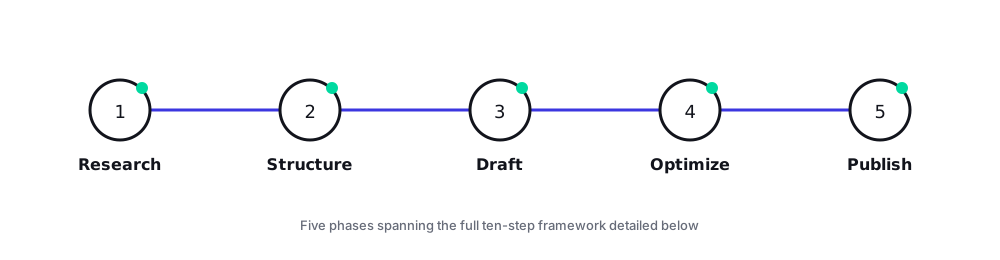
Complete Operating Procedure
The operating rhythm
Preparation \u2192 Planning \u2192 Execution \u2192 Review \u2192 Optimization \u2192 Maintenance, running continuously rather than as a one-time project.
Preparation: define your audience and positioning, set up a basic tool stack, and establish a brand voice guide.
Planning: build a backlog of 15-20 candidate topics from real customer questions, and assign a rough publishing calendar.
Execution: work the ten-step framework for each piece, request reviews at a consistent trigger point, and distribute finished content across your other channels.
The Review, Optimization, and Maintenance Phases
Review: monthly, check which pieces are attracting traffic or leads and which are not; add newly surfaced questions to the backlog.
Optimization: find patterns in your best performers and refresh underperforming-but-relevant older posts rather than always starting from zero.
Maintenance: keep the backlog topped up continuously, and audit older content periodically for outdated facts or broken links.
Tools and Resources
| Tool Type | What It’s For | When to Use It |
|---|---|---|
| Research/citation AI assistant | Gathering sourced, factual information before writing | Early in the workflow, before drafting begins |
| General-purpose writing AI | Drafting outlines and prose in a defined voice | After research is gathered and a voice guide is set |
| AI image generator | Feature and supporting visuals in a consistent style | When a piece needs a header image or visual break |
| Content calendar / backlog | Tracking ideas, schedule, and completed pieces | Ongoing, the operational backbone of the system |
| Review-request workflow | Prompting reviews at a consistent moment | Immediately after a positive customer interaction |
| Basic analytics | Measuring which content actually drives traffic or leads | Monthly, as part of the review phase |
Best Practices
- Always confirm intent before creating content, quality can’t compensate for the wrong target.
- Separate research from writing to reduce unsupported claims.
- Draft in stages: outline, then sections, never one uncontrolled pass.
- Treat headings, alt text, and internal/outbound links as mandatory, not optional polish.
- Keep a running backlog fed by real audience questions.
- Build reviews into the standard customer journey, not an afterthought.
- Prioritize consistency over intensity, a sustainable cadence maintained for months outperforms any single burst.
- Refresh older content instead of treating publication as the end of its life.
Common Mistakes
| Mistake | Why It Happens | How to Fix It |
|---|---|---|
| Content doesn’t match search intent | Assuming intent from the keyword alone | Search the phrase yourself before writing |
| Requesting a whole article in one AI prompt | Wanting speed over control | Outline first, then draft in small increments |
| Skipping alt text | Treated as a minor afterthought | Make it a non-negotiable checklist item |
| Never linking outward | Fear of ‘sending traffic away’ | Recognize outbound links build trust and credibility |
| Publishing sporadically | Treating marketing as a project, not an operation | Set a lower but genuinely sustainable cadence |
| Not asking for reviews | Assuming happy customers volunteer them | Build a specific request into the customer journey |
Advanced Strategies
These build on the fundamentals above and are best applied once the core workflow runs consistently.
- Structured data for FAQs can make content eligible for enhanced search result displays.
- Content refresh cycles, systematically revisiting older posts, often regain performance faster than new content builds it from zero.
- Performance-based prioritization reshapes the backlog using real analytics rather than treating every idea as equally valuable.
- Cross-channel repurposing turns one researched piece into a social post, a short video, and a newsletter excerpt.
- Batch production, research five topics in one sitting, then draft five in another, produces faster, more consistent output than constant tool-switching.
- Referral-loop design turns passive hope into an active mechanism that prompts satisfied customers to promote you.
Practical Examples
Local service business: a landscaping company confirms that “how to fix bare lawn patches” is informational, mines related questions about grass seed and timing, sources agronomy facts, drafts a guide with an internal link to its own seasonal service page, and closes with an FAQ, steadily attracting homeowner search traffic within a few months.
Local retail business: an allergen-free bakery positions itself narrowly, builds content around the exact questions customers ask at the counter, and trains staff to request a review right at pickup, compounding both search visibility and word-of-mouth trust around its one clear differentiator.
Professional services: a small accounting firm commits to one thorough guide per week (a sustainable limit given staff time), draws its backlog from real client tax questions, and refreshes prior guides each filing season instead of rewriting them from scratch, preserving accumulated visibility while keeping facts current.
Quick Reference Checklist
Quick reference checklist
- Confirmed search intent against live results
- Selected a real audience question
- Gathered sourced research with citations
- Set a consistent voice before drafting
- Approved an outline before full prose
- Drafted in reviewable increments
- Applied consistent heading hierarchy
- Added at least one outbound and one internal link
- Added images with accurate alt text
- Added a genuinely relevant FAQ section
- Completed a full continuity read-through
- Logged the topic and reviewed performance monthly
Key Takeaways
- Marketing growth is a system, not a single campaign, consistency over months matters more than any one piece.
- Intent-matching is the foundation everything else builds on.
- AI tools are a force-multiplier wrapped around a deliberate process, not a shortcut around quality.
- Structural basics, headings, alt text, links, are inexpensive but consistently under-applied.
- Reputation and referrals deserve the same deliberate process as content creation.
- A running backlog of real audience questions keeps the whole system fed.
- Review and refresh what you’ve already built rather than only creating new.
Guides in This Playbook
Every phase of the framework above links to a dedicated, step-by-step guide on this site. Start wherever your business has the biggest gap right now:
- How to Find Keywords for Your Business
- How to Get More Organic Traffic
- How to Get Your Website Indexed by Google
- How to Build Backlinks for Your Small Business
- Local SEO for Small Business
- Email Marketing for Small Business
- How to Optimize Your Google Business Profile
- How to Get More Google Reviews Without Asking
- Google Ads for Beginners
- How to Build a Homepage That Converts
- How to Create Calls-to-Action That Get Clicks
- Leadership Begins Long Before Anyone Gives You a Title (the trust-and-leadership series)
Frequently Asked Questions
How long does it take to see results from this approach?
Most businesses following a consistent weekly cadence begin seeing measurable organic traffic within two to three months, with results compounding as the content library grows.
Do I need a big budget to start?
No. The core workflow, research, structured drafting, on-page SEO, and a review-request habit, runs on free or low-cost tools and mainly requires consistent time.
Is AI-written content penalized by search engines?
No. Search engines penalize low-quality, generic content, not the use of AI. A grounded process with sourced research and human review produces content that performs the same as traditionally written content.
How many blog posts should a small business publish per week?
A sustainable cadence beats an ambitious one you abandon. One solid, well-researched post per week is a legitimate and effective starting point.
What matters more, content or reviews?
They compound together. Content builds search visibility for people who don’t know you yet; reviews build the trust that converts people who are already considering you.
Ready to put this system to work? See how we help small businesses run this playbook, or read our related piece on the five-phase trust process behind sustainable growth.